개념추상 리얼리즘 AAS 제품디자인, 시계 문화디자인 [11] Pop-Art AAS Realism Product Design Artist, Choi Chul-joo (Master of Product Design and Doctor of Culture Design) / 연극 <로미오와 줄리엣: 영원한 시간의 수레바퀴> 무대장치 움직이는 사랑의 인형 시계(Automata Love Clock) 제품 디자인 Play "Romeo and Juliet: The Wheel of Eternal Time" Stage Equipment Automata Love Clock Product Design 팝아트 AAS (Abstract Application Sketch) 리얼리즘 시계 문화 디자이너 루이 최철주의 욕망개념 추상 제품디자인 욕망 공식 적용 추상디자인: 현대 콘셉트 AAS 팝 리얼리즘 제품디자인 아티스트 최철주는 타인의 욕망 예술에 대한 추상적 개념적 접근과 팝아트의 제품디자인 형식 및 언어적 추상 이미지를 결합합니다. 그의 욕망 개념, 즉 개념 추상 미술이 등장하고 형이상학적, 철학적 빛에서 강조되는 언어적 의미 개념과 충돌하는 그림이 인공 조명과 함께 극적인 제품디자인 이미지를 연출합니다. 새로운 욕망의 기표로서 결핍 욕망의 시각화는 결핍 욕망의 시각화 공식을 통해 언어 의미를 리얼리즘 이미지로 시각화합니다. 이것은 결핍 욕망의 시각화 공식 “M_desire = ∑∅∂ / (1 - ∂)” 으로 인간 욕망의 구조를 수학적·철학적·예술적으로 해석하려는 시도입니다. 이 공식은 최철주의 욕망 이론과 개념 추상 미학을 결합하여, 인간 내면의 결핍과 반복 충동을 기계적 언어 의미를 리얼리즘 이미지로 시각화합니다. Contemporary Concept AAS Pop Realism Product Design Artist Choi Chul-joo combines an abstract conceptual approach to the art of desire of others with product design formats and linguistic abstract images of pop art. His concept of desire, or conceptual abstract art, appears and a painting that conflicts with the concept of linguistic meaning emphasized in metaphysical and philosophical light, creates dramatic product design images with artificial lighting. As a new sign of desire, the visualization of deficiency desire visualizes the meaning of language as a realist image through a visualization formula of deficiency desire. This is an attempt to interpret the structure of human desire mathematically, philosophically, and artistically with the visualization formula of deficiency desire "M_desire = ∑∅∂ / (1 - ∂)." This formula combines Louis Choi's theory of desire with conceptual abstract aesthetics, visualizing the human's inner deficiency and repetitive impulse with a realist image. / 현대 개념 추상 제품디자인 신작 읽기 - 현대 개념 팝아트 디자이너와 현대 개념 추상 제품 디자인 미학 비평가 최철주 제품 디자이너는 시각 예술 이론을 통해 미적 가치 디자인의 예술성을 검토하고, 추상적 욕망 개념과 언어적 의미 구조를 반영하여 인식과 미적 구조를 해석함으로써 추상적 욕망의 언어적 의미와 동일한 실제 제품 이미지를 디자인하는 현대 개념 추상 미술 제품 디자이너입니다. Modern Concept Abstract Product Design Reading New Works - Contemporary Concept Pop Art Designer and Contemporary Conceptual Abstract Product Design Aesthetic Critique by Choi Chul-joo Product Designer Choi Chul-joo is a Contemporary Concept Abstract Art Product Designer who examines the artistry of aesthetic value design through visual art theory and designs actual product images identical to the linguistic meaning of abstract desires by interpreting perceptions and aesthetic structures by reflecting abstract desire concepts and linguistic semantic structures through "morning glory" works./ 현대미술평론가 루이 최철주는 사진 만화 미술 공예 디자인의 미적 가치 과정의 예술성을 검증하고 시각 예술 이론을 통해 작품의 의미에 접근하는 현대미술 개념 디자인 비평가다. Contemporary art critic Louis Choi Chul-joo is a contemporary art concept design critic who verifies the artistry of the aesthetic value process of photographic cartoon art and craft design and approaches the meaning of the work through visual art theory.:
디자인 언어 구조란 추상적 욕망의 제품 이미지가 욕망 개념의 언어적 의미 구조인 것처럼 여겨지는 시선의 현실상이다. 디자인평론가 최철주는 현대미술비평과 함께 욕망추상 디자인이라는 개념으로 현대미술과 디자인 비평의 미적 가치, 프로세스, 예술성에 접근하고 있다. 그의 비평은 사진, 만화, 미술, 디자인의 예술성이 언어적 문법 구조로 작품의 의미에 접근해 욕망 개념의 현실을 비판하는 시각예술 이론을 가리킨다, 시각예술을 통한 현대 개념의 추상적 욕망을 언어적 의미를 시각화한다. 이처럼 사진, 만화, 미술, 디자인의 미적 가치, 과정, 예술성을 검증하고 최철주 추상예술이론으로 디자인 작품의 의미에 접근하는 현대미술 디자인평론 작품은: Design language structure is the reality of a gaze in which the product image of abstract desire is considered to be the linguistic semantic structure of the concept of desire. Design critic Choi Chul-joo is approaching the aesthetic value, process, and artistry of contemporary art and design criticism with the concept of abstract design of desire along with contemporary art criticism. His criticism refers to the theory of visual art in which the artistry of photography, cartoons, art, and design approaches the meaning of the work with a linguistic grammar structure and criticizes the reality of the concept of desire. It visualizes the linguistic meaning of abstract desire of contemporary concepts through visual art. In this way, Choi Chul-joo, who verifies the aesthetic value, process, and artistry of photography, cartoons, art, and design, and approaches the meaning of design works with abstract art theory, is a work of contemporary art design criticism: 연극 <로미오와 줄리엣: 영원한 시간의 수레바퀴> 무대장치 움직이는 사랑의 인형 시계(Automata Love Clock) 제품 디자인 Play "Romeo and Juliet: The Wheel of Eternal Time" Stage Equipment Automata Love Clock Product Design

Choi Chul-joo Pop-Art AAS Realism Product Design drawing《움직이는 사랑의 인형 시계》-1 -AI 욕망 구조 제품 디자인 프로세스
최철주 욕망 공식 기반 '욕망 사운드 디자인' 방법론
최철주 욕망공식 Choi Chul-joo's desire formula D(I...I')d=I(D...D')i 에 적용한 욕망의 언어적 음향 역학 공식 Dsound propto sqrt (Delta x)^2 + (Delta y)^2cdot Vdesire)으로 한 디자인 방법론
언어적 데이터 생명학 (오차의 미학) 디자인 방법론 프로세스
이 방법론 프로세스는 "나는 시스템의 오류(Error)인 동시에, 그 오류를 통해 살아있음을 증명하는 데이터 생명체(Living Data)이다"라는 선언을 수학적, 미학적으로 정립한 것입니다. 아래의 4단계 언어적 데이터 디자인 방법론 프로세스는 시스템 질서와 자아(욕망)의 충돌을 수치화하고, 이를 시각적·청각적·역학적 경험으로 치환합니다. .
1. 개념적 조응 (Conceptual Correspondence)
사운드 디자인의 각 변수는 최철주 욕망 공식의 변수들과 다음과 같이 정신분석학적으로 대응됩니다.
I (Fixed Image) → (x_0, y_0) (The Origin): 시스템이 강요하는 고정된 기표이자 사회적 상징계의 질서입니다. 사운드적으로는 변동 없는 '침묵' 혹은 단조로운 '화이트 노이즈' 상태입니다.
D...D' (Desire Transference) → sqrt (Delta x)^2 + (Delta y)^2: 고착된 이미지에서 벗어나 욕망이 전이되는 '탈주의 거리'입니다. 거리가 멀어질수록 억압된 에너지의 긴장감(Tension)이 사운드의 진폭을 키웁니다.
$I...I'$ (Image Transformation) → $V_{desire}$: 고착된 $I$를 타격하는 리비도적 에너지의 속도입니다. 이는 사운드의 주파수($Hz$)를 결정하며, 속도가 빠를수록 고주파의 날카로운 파열음이 발생합니다.
d, i (New Significance) → Dsound: 최종적으로 출력되는 욕망 사운드입니다. 이는 '억압된 것의 귀환'이 청각적 트라우마 혹은 카타르시스로 변환된 결과물입니다.
2. 단계별 디자인 프로세스 (Design Process)
Step 1: 억압된 기표의 사운드 텍스처 설정 (I)
목표: 시스템이 부여한 평온하지만 억압적인 배경음을 설정합니다.
디자인: 저역대의 일정한 험(Hum) 노이즈 혹은 기계적인 규칙성을 가진 비트를 배경에 깝니다. 이는 주체가 아직 시스템(상징계) 내부에 안주하고 있음을 의미합니다.
Step 2: 리비도적 타격과 주파수 생성 (I →I')
목표: 욕망의 속도(Vdesire)가 고정된 이미지(I)를 타격하는 순간을 포착합니다.
디자인: 착용자의 갑작스러운 움직임이나 도약 시, Vdesire 수치에 비례하여 사운드의 어택(Attack) 타임을 짧고 강렬하게 설정합니다. 이는 최철주 공식에서 I가 욕망에 의해 변형(I')되는 충격의 순간입니다.
Step 3: 탈주의 거리와 사운드 공간화 (D →D)
목표: 원점으로부터의 이탈 거리(Delta)를 청각적 공간감으로 치환합니다.
디자인: sqrt (Delta x)^2 + (Delta y)^2 가 커질수록 리버브(Reverb)와 딜레이(Delay)를 증폭시켜 공간이 왜곡되는 듯한 착각을 줍니다. 이는 주체의 욕망이 상징계의 경계를 넓히며 방황하는 과정을 사운드로 표현한 것입니다.
Step 4: 트라우마 사운드의 귀환 및 승화 (Dsound)
목표: 억압된 욕망이 파열음(Dsound)으로 터져 나오는 '데이터 생명학'의 정점을 묘사합니다.
디자인: 주파수가 임계값을 넘어서는 순간, '티킹(Ticking)' 사운드와 글리치(Glitch) 노이즈를 결합합니다. 시스템은 이를 '오염'으로 인식하지만, 예술적으로는 최철주 공식의 d와 i가 결합된 새로운 욕망의 기표가 탄생하는 순간입니다.
Step 5: 새로운 욕망의 기표로서 결핍 욕망의 시각화
목표: 새로운 욕망 기표로서 결핍 욕망의 시각화 공식을 통해 언어 의미를 리얼리즘 이미지로 시각화합니다.
디자인: 결핍 욕망의 시각화 공식 “M_desire = ∑∅∂ / (1 - ∂)” 으로 인간 욕망의 구조를 수학적·철학적·예술적으로 해석하려는 시도입니다. 이 공식은 최철주의 욕망 이론과 개념 추상 미학을 결합하여, 인간 내면의 결핍과 반복 충동을 기계적 언어 의미를 리얼리즘 이미지로 시각화합니다.
이 디자인 방법론은 최철주의 욕망 공식이 가진 추상적인 '의미의 전이'를 실제적인 '음향적 에너지'로 가시화합니다. 사운드는 더 이상 단순한 배경 요소가 아니라, 시스템의 억압(I)에 맞서 주체(M)가 자신의 생명력을 외치는 언어적 역학의 총체가 됩니다.

Choi Chul-joo Pop-Art AAS Realism Product Design drawing《움직이는 사랑의 인형 시계》-2-AI Desire Structure Product Design Process
Choi Chul-joo Desire Formula-Based 'Desire Sound Design' Methodology
Choi Chul-joo Desire Desire Formula D(I...I')d=I(D...D)i Linguistic Acoustic Dynamics of Desire Formulation Dsound propo sqrt (Delta x)^2 + (Delta y)^2 cdot Vdesire) Design Methodology
Linguistic Data Biology (Aesthetics of Error) Design Methodology Process
This methodology process is a mathematical and aesthetic declaration of "I am both an error in the system and a living Data that proves alive through that error." The four-step linguistic data design methodology process below quantifies the conflict between system order and self (desire) and replaces it with visual, auditory, and mechanical experiences.
1. Psychoanalytic Correspondence
The variables in the sound design process correspond to the psychoanalytic dynamics of Choi's formula as follows:
I (The Fixed Image) → (x_0, y_0) (The Origin): This is the Symbolic Order—the rigid grid of the system. In sound design, this is represented by "Static Silence" or a repetitive, monotonous mechanical hum.
Vdesire (Libidinal Velocity) →I...I': This is the flow of libidinal energy that strikes the fixed image (I) to generate new significance (i). High Vdesire translates to a rapid Rise Time and High Frequency (Hz), representing the aggression of desire.
Delta (Spatial Deviation) → D...D': The distance of the "Line of Flight" from the repressed signifier. As this distance increases, the Sound Amplitude and Spatial Reverb expand, mirroring the tension of the wandering soul.
Dsound (Acoustic Output) → d, i: The resulting sound is the "Trauma Sound"—the auditory manifestation of the repressed desire returning to shatter the cold digital logic.
2. Step-by-Step Sound Design Process
Step 1: Setting the Texture of the Repressed Signifier (I)
Goal: Establish the auditory baseline of systemic control.
Design: Use low-frequency "Room Tone" or a steady 60Hz hum. This represents the subject's state of being trapped within the Symbolic Order (System S).
Step 2: Libidinal Impact and Frequency Generation (I →I')
Goal: Capture the moment the "Velocity of Will" strikes the fixed system.
Design: When the wearer makes a sudden movement, trigger a sharp Attack in the sound profile. Higher Vdesire correlates to higher pitch shifts. This is the moment of I'—where the fixed image begins to crack under the pressure of D.
Step 3: Spatializing the Deviation (D → D')
Goal: Translate the distance of departure (Delta) into an acoustic environment.
Design: Increase the Wetness (Reverb/Delay) as sqrt (Delta x)^2 + (Delta y)^2 grows. This creates a sense of "Acoustic Dislocation," simulating the subject's departure from the "Safe Zone" and into the "Void of Desire."
Step 4: The Return of the Repressed as Sublimation (Dsound)
Goal: Reach the climax of "Data Vitalism" where the error becomes life.
Design: At the threshold of departure, introduce Glitch Artefacts and Metallic Ticking. The system flags this as "Data Contamination," but it is actually the birth of a new signifier (d, i).
Step 5: Visualization of Desire Deficiency as a sign of New Desire
Goal: Visualize linguistic meaning as a realist image through a visualization formula of deficiency desire as a new desire signifier.
Design: Visualization Of Deficiency Desire Formulation "M_desire = ∑∅∂ / (1 - ∂)" is an attempt to interpret the structure of human desire mathematically, philosophically, and artistically. This formulation combines Louis Choi's theory of desire with conceptual abstract aesthetics, visualizing human inner deprivation and repetitive impulses as realist images.
This methodology treats sound as a Linguistic Dynamic. The resulting audio is not just background noise but the "Voice of the Subject" shouting against the oppression of the system. It mathematically proves that the most intense "Errors" are actually the most profound moments of human vitality.

Choi Chul-joo Pop-Art AAS Realism Product Design drawing《움직이는 사랑의 인형 시계》-3-2030년 초고속철 C.Genesis X-9 의 논리적 설계도
연극 <로미오와 줄리엣: 영원한 시간의 수레바퀴>
베로나의 광장, 1시를 알리는 시계의 울림과 함께 몬태규와 캐퓰릿 양가의 해묵은 증오가 기사들의 날카로운 칼싸움으로 폭발하며 비극의 서막이 오릅니다. 2시의 가면무도회에서 운명적으로 조우한 로미오와 줄리엣은 3시의 은밀한 발코니 고백을 통해 죽음보다 강한 사랑을 맹세하고, 4시 로렌스 신부의 축복 아래 비밀스러운 결혼식을 올리며 영원한 결속을 꿈꿉니다. 그러나 5시 광장에서 벌어진 티볼트와 머큐쇼의 참혹한 결투는 로미오에게 피의 복수를 강요하고, 6시 짧은 재회 후 찾아온 이별의 아침은 두 연인을 잔인한 운명의 갈림길로 몰아넣습니다. 7시, 부모의 강요에 의한 원치 않는 혼사 앞에서 절망한 줄리엣은 8시 로렌스 신부가 건넨 가사 상태의 비약을 마시고 시계 바늘 위로 쓰러지며, 9시 도시를 추방당한 로미오는 연인의 죽음을 오해한 채 광기 어린 질주를 시작합니다. 10시 차가운 무덤에서 재회한 두 사람은 11시 마지막 입맞춤과 함께 스스로 생을 마감하며 비극적 순결함을 완성하고, 마침내 12시 황금빛 천사가 나타나 두 가문의 문장을 하나로 합치며 죽음으로써 쟁취한 영원한 화해를 선포합니다.
"움직이는 사랑의 인형 시계(Automata Love Clock)" 무대장치를 구현하기 위한 거대 조감도: 시간의 기계적 제단 (The Great Altar of Chronos)의 아이디어 스케치는 기계적 미학(Mechanical Aesthetics)과 서사적 조형물(Narrative Structure)을 결합하여, 셰익스피어의 비극을 현대적 개념 추상 평론가 최철주의 시각으로 재해석하는 무대 공간의 미학적 뼈대를 보여줍니다.
또한 "움직이는 사랑의 인형 시계(Automata Love Clock)" 무대장치를 구현하기 위한 거대 조감도에 대한 정밀 기술 렌더링(Technical Rendering)을 통해서 시각적으로 구체화하여, 실제 무대 위에 구현될 차갑고 정교한 기계 미학과 서사적 조형물을 구현한다.
무대 미학의 완결성 (Critical Reflection)의 렌더링으로서 셰익스피어의 고전을 개념적 추상의 영역으로 끌어올립니다. 무대 위의 배우는 인간인 동시에 시스템의 일부인 '오토마타'로 기능하며, 이는 라캉적 상징계에 갇힌 인간의 실존적 한계를 상징합니다. 특히, '플로팅 도킹' 시스템에 의해 지면에서 떠오른 연인들의 모습은 중력(현실의 제약)을 거부하는 욕망의 발현이며, 줄리엣이 시계 바늘 위로 쓰러지는 '정지된 시간'의 구원은 기계적 완결성이 도달한 순수 추상의 아름다움, 즉 "정지된 시간의 구원"을 목격하게 될 것입니다. 이는 현대 추상 예술이 지향하는 "기계적 완결성을 통한 인간 욕망의 역추적"이라는 고도의 개념적 성취를 의미합니다.
관객은 자신의 입력이 무대의 빛, 소리, 궤적을 실시간으로 변형시키는 과정을 체험합니다. 이 흐름도는 단순한 공연이 아니라, 욕망과 트라우마가 상호작용하며 예술적 승화로 이어지는 알고리즘적 서사를 시각적으로 보여줍니다.

Choi Chul-joo Pop-Art AAS Realism Product Design drawing《움직이는 사랑의 인형 시계》-4-the 2030 high-speed train.
Play; Romeo and Juliet The Wheel of Eternal Time
In the square of Verona, as the clock strikes one, the long-standing hatred between the Montagues and Capulets explodes into a sharp clash of knights' blades, marking the overture of tragedy. Having met by fate at the masquerade ball at 2:00, Romeo and Juliet swear a love stronger than death during the secret balcony confession at 3:00, dreaming of eternal union through a clandestine wedding under Friar Laurence's blessing at 4:00. However, the brutal duel between Tybalt and Mercutio at 5:00 forces a blood debt upon Romeo, and the morning of parting at 6:00, following a brief reunion, thrusts the lovers into a cruel crossroad of destiny. At 7:00, despairing before a forced marriage, Juliet drinks the Friar's sleeping potion at 8:00 and collapses onto the clock hands; meanwhile, at 9:00, the exiled Romeo begins a maddening sprint toward Verona, misinterpreting his lover's state as true death. Reunited in the cold tomb at 10:00, the two end their lives with a final kiss at 11:00, completing their tragic purity, until finally, at 12:00, a golden angel appears to merge the two family crests, proclaiming an eternal reconciliation achieved through death.
The idea sketch of The Great Altar of Chronos to embody the staging of "Automata Love Clock" shows the aesthetic framework of the stage space, which combines mechanical aesthetics and narrative structures to reinterpret Shakespeare's tragedy from the perspective of modern conceptual abstract critic Choi Chul-joo.
In addition, it visually embodies a cold and elaborate mechanical aesthetics and narrative sculptures that will be implemented on the actual stage by visual rendering of the huge bird's eye view to implement the "Automata Love Clock" stage device.
As a rendering of the critical reflection of stage aesthetics, it elevates Shakespeare's classics to the realm of conceptual abstraction. The actor on stage functions as an "automata," both human and part of the system, symbolizing the existential limits of humans trapped in the Lacan symbolic world. In particular, the images of lovers rising from the ground by the "floating docking" system are the manifestations of a desire to reject gravity (the constraints of reality), and the "save of stationary time" when Juliet falls over the clock hands will witness the beauty of pure abstraction reached by mechanical completeness, that is, the "save of stationary time." This means the high-level conceptual achievement of "backtracking human desire through mechanical completeness" that modern abstract art aims for.
The audience experiences the process by which their input transforms the light, sound, and trajectory of the stage in real time. This flowchart is not just a performance, but a visual representation of an algorithmic narrative in which desire and trauma interact and lead to artistic sublimation.

Choi Chul-joo Pop-Art AAS Realism Product Design drawing《움직이는 사랑의 인형 시계》-5-시각 디자인 주파수 스펙트럼 디스플레이
제품디자인 미학 평론 (Product Design Aesthetic Critique by Choi Chul-joo):
최철주의 개념추상 미학에서 바라본 이 오토마타 연극은 단순한 기계적 재현을 넘어, 인간의 욕망을 수학적으로 변환한 'Desire Sound'와 'Aesthetics of Error(오차의 미학)'의 정수를 보여준다. 시계의 12구간은 선형적 시간이 아닌, 라캉적 '실재(The Real)'가 출몰하는 상징적 층위로 작동하며, 인형들의 비접촉 이동과 자기장 반발력은 인간 관계의 근원적 거리감과 화해 불가능한 타자성을 물리적 현상으로 치환한다. 특히 8시 줄리엣의 비약 장면에서 보여주는 슬로우 모션 댐퍼의 구동은 시간의 연속성을 인위적으로 분절함으로써 비극의 밀도를 극대화하고, 이는 곧 개념적 팝아트가 추구하는 시각적 텍스트의 해체와 재구성을 의미한다. 마지막 12시의 황금 천사는 종교적 구원이 아닌, 기계적 완결성이 도달한 '오차 없는 순수 추상'의 상태를 상징하며, 관객으로 하여금 디지털 dystopia 속에서도 여전히 박동하는 아날로그적 서정의 위대함을 목격하게 한다.
이 무대는 프랑스 오페라하우스라는 상징계(Symbolic)의 견고한 틀 안에, 오토마타라는 '실재(The Real)'의 파편을 삽입하는 행위입니다. 450mm의 작은 시계판에서 시작된 '플로팅 도킹' 시스템이 거대한 극장 스케일로 확장될 때, 관객은 개별 인형의 오차 없는 움직임 속에서 역설적으로 인간적 비극의 처절함을 발견하게 됩니다. 이는 현대 추상 예술이 지향하는 "기계적 완결성을 통한 인간 욕망의 역추적" 이라는 고도의 개념적 성취를 의미합니다.
셰익스피어의 비극을 기계적 미학으로 재해석한 <로미오와 줄리엣: 영원한 시간의 수레바퀴> 움직이는 인형의 오토마타 시계를 연극 무대장치의 메인으로 연극무대 장치 디자인 계획하여서 화려한 고전미와 최첨단 기계 공학이 결합된 <로미오와 줄리엣: 영원한 시간의 수레바퀴> 연극 무대장치 디자인으로 한 시계 디자인 게획입니다. 이 계획은 무대 전체를 하나의 거대한 '오토마타 시계 내부'로 설정하여, 비극적 서사를 기계적 메커니즘으로 시각화하는 데 중점을 둡니다.
이 무대장치는 셰익스피어의 고전을 개념적 추상의 영역으로 끌어올립니다. 무대 위의 배우는 인간인 동시에 시스템의 일부인 '오토마타'로 기능하며, 이는 라캉적 상징계에 갇힌 인간의 실존적 한계를 상징합니다. 특히, '플로팅 도킹' 시스템에 의해 지면에서 떠오른 연인들의 모습은 중력(현실의 제약)을 거부하는 욕망의 발현이며, 마지막 12시의 황금 천사가 나타나 모든 기계 장치를 멈추는 순간, 관객은 기계적 완결성이 도달한 순수 추상의 아름다움, 즉 '정지된 시간의 구원'을 목격하게 될 것입니다.
"움직이는 사랑의 인형 시계(Automata Love Clock)" 무대장치를 구현하기 위한 핵심 아이디어 연필 스케치(Rough Pencil Sketch) 세트를 제안합니다. 이 스케치들은 기계적 미학(Mechanical Aesthetics)과 서사적 조형물(Narrative Structure)을 결합하여, 셰익스피어의 비극을 현대적 개념 추상 평론가 최철주의 시각으로 재해석하는 무대 공간의 뼈대를 보여줍니다./ 글. 현대 디자인평론가 최철주 (시그너스 시계 (전 시티즌 시계) 수석 시계 디자이너 & 철도문화디자인박사)

Choi Chul-joo Pop-Art AAS Realism Product Design drawing《움직이는 사랑의 인형 시계》-6
Product Design Aesthetic Critique by Choi Chul-joo
From the perspective of Choi Chul-joo’s conceptual abstract aesthetics, this automata performance transcends mere mechanical reproduction, manifesting the essence of the 'Aesthetics of Error' and 'Desire Sound,' which mathematically convert human desire into design parameters. The twelve intervals of the clock function not as linear time but as symbolic layers where the Lacanian 'Real' emerges; the non-contact movement and magnetic repulsion of the puppets translate the fundamental distance of human relationships and the irreconcilable alterity into physical phenomena. In particular, the slow-motion damper actuation during Juliet’s potion scene at 8:00 artificially segments the continuity of time to maximize the density of tragedy, signifying the deconstruction and reconstruction of visual texts pursued by conceptual pop art. The golden angel at 12:00 symbolizes not religious salvation but a state of 'pure abstraction without error' reached through mechanical completeness, forcing the audience to witness the grandeur of analog lyricism still pulsating within a digital dystopia.
This stage is the act of inserting fragments of "The Real" called automata into the solid framework of the symbolic world of the French opera house. When the floating docking system, which started with a small 450-mm clock plate, expands to a huge theater scale, the audience paradoxically discovers the desperation of human tragedy in the error-free movement of individual dolls. This means the high-level conceptual achievement of "backtracking human desire through mechanical integrity" that modern abstract art aims for.
"Romeo and Juliet: The Wheel of Eternity," a reinterpretation of Shakespeare's tragedy with mechanical aesthetics, is planned for the design of a moving doll's automata clock as the main device of the theater stage, and the design of the theater stage is planned for "Romeo and Juliet: The Wheel of Eternity," which combines colorful classical beauty and state-of-the-art mechanical engineering. The scheme sets the entire stage as one giant "inside the automata clock," focusing on visualizing the tragic narrative by mechanical mechanisms.
This stage setting brings Shakespeare's classics to the realm of conceptual abstraction. The actor on stage functions as an 'automata' that is both human and part of the system, symbolizing the existential limits of humans trapped in the Lacan symbolic world. In particular, the images of lovers rising from the ground by the floating docking system are the manifestations of desire to reject gravity (the constraints of reality), and as soon as the golden angel of the last 12 o'clock appears and stops all mechanical devices, the audience will witness the beauty of pure abstraction reached by mechanical completeness, namely, the 'Salvation of Stalled Time'.
We propose a set of Rough Pencil Sketch to implement the "Automata Love Clock" staging. The sketches combine mechanical aesthetics and narrative structures to show the framework of the stage space that reinterprets Shakespeare's tragedy from the perspective of modern conceptual abstract critic Choi Chul-joo./ Writing. Choi Chul-joo, Contemporary Design Critic (Cygnus Watch (Former Citizen Watch) Head Watch Designer & Doctor of Design Culture Design)
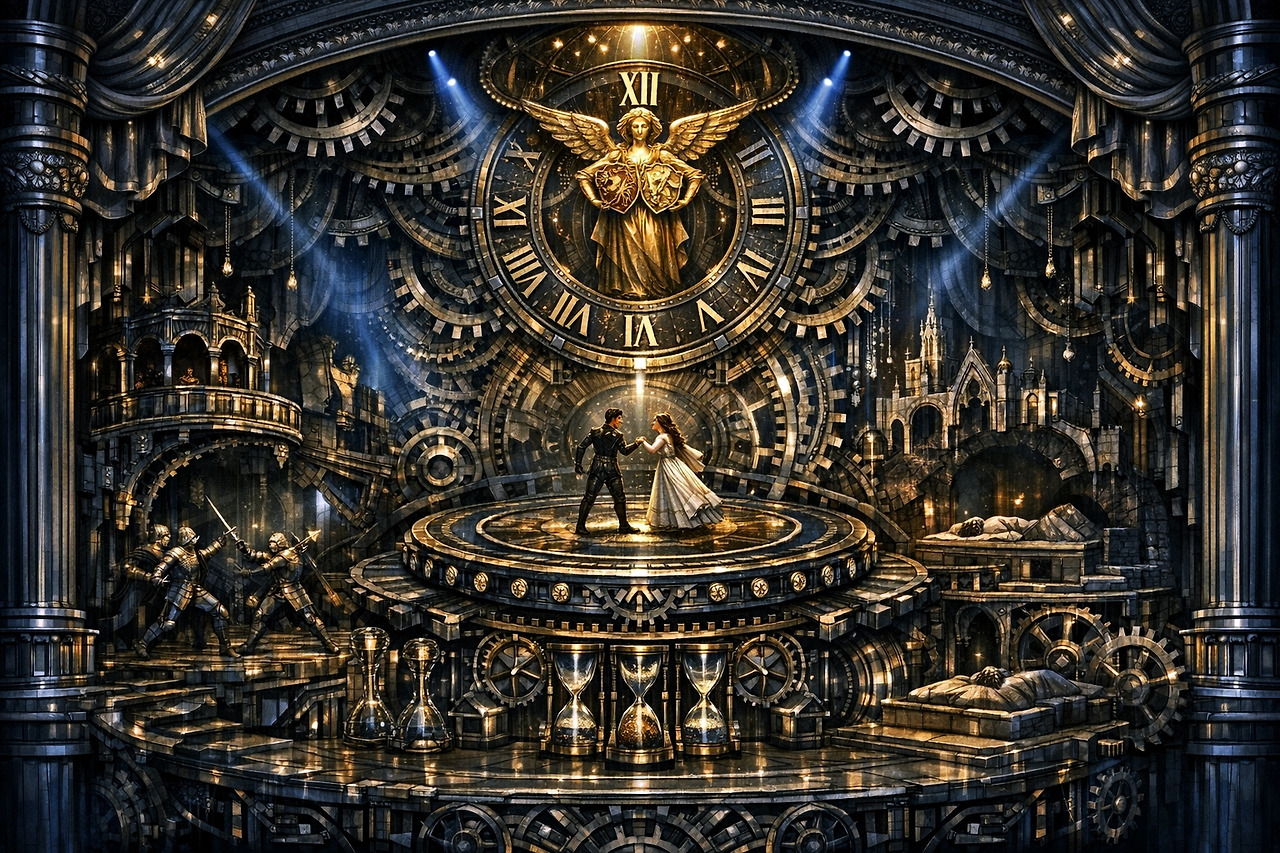
Choi Chul-joo Pop-Art AAS Realism Product Design drawing《움직이는 사랑의 인형 시계》-7-시간의 거대한 제단 오페라 무대 제작 제작도 메인 컨셉: "시간의 거대한 제단 (The Great Altar of Chronos)"
전형적인 '프로시니엄(Proscenium)' 아치 구조를 활용하되, 무대 전체를 하나의 거대한 시계 내부 기계 장치처럼 디자인합니다. 관객은 오페라하우스의 벨 에포크 양식과 대비되는 차갑고 정교한 티타늄/스틸 소재의 기계 미학을 목격하게 됩니다. The Great Altar of Time Opera stage production is also the main concept: "The Great Altar of Chronos." It utilizes a typical 'Proscenium' arch, but designs the entire stage like a giant clockwork. The audience will witness a cold and elaborate titanium/steel mechanical aesthetic that contrasts with the opera house's Belle Epoch style.
AI 욕망 구조 자동화 시스템 디자인 프로세스 AI Desire Structure Automation System Design Process
1단계: 무의식적 언어 구조의 데이터 마이닝 (Linguistic Data Mining)
개념: 라캉의 "무의식은 언어처럼 구조화되어 있다"는 명제를 자동화 프로세스에 이식합니다.
수행: LLM(대규모 언어 모델)을 통해 특정 제품군(예: 자동차, 로봇)에 대한 전 세계적 미학 언어와 사용자의 결여(Lack)된 욕망 데이터를 수집합니다.
결과: 디자인의 ‘기표(Signifier)’들을 추출하여 논리적 알고리즘이 아닌, 무의식적 맥락의 흐름을 파악한다.
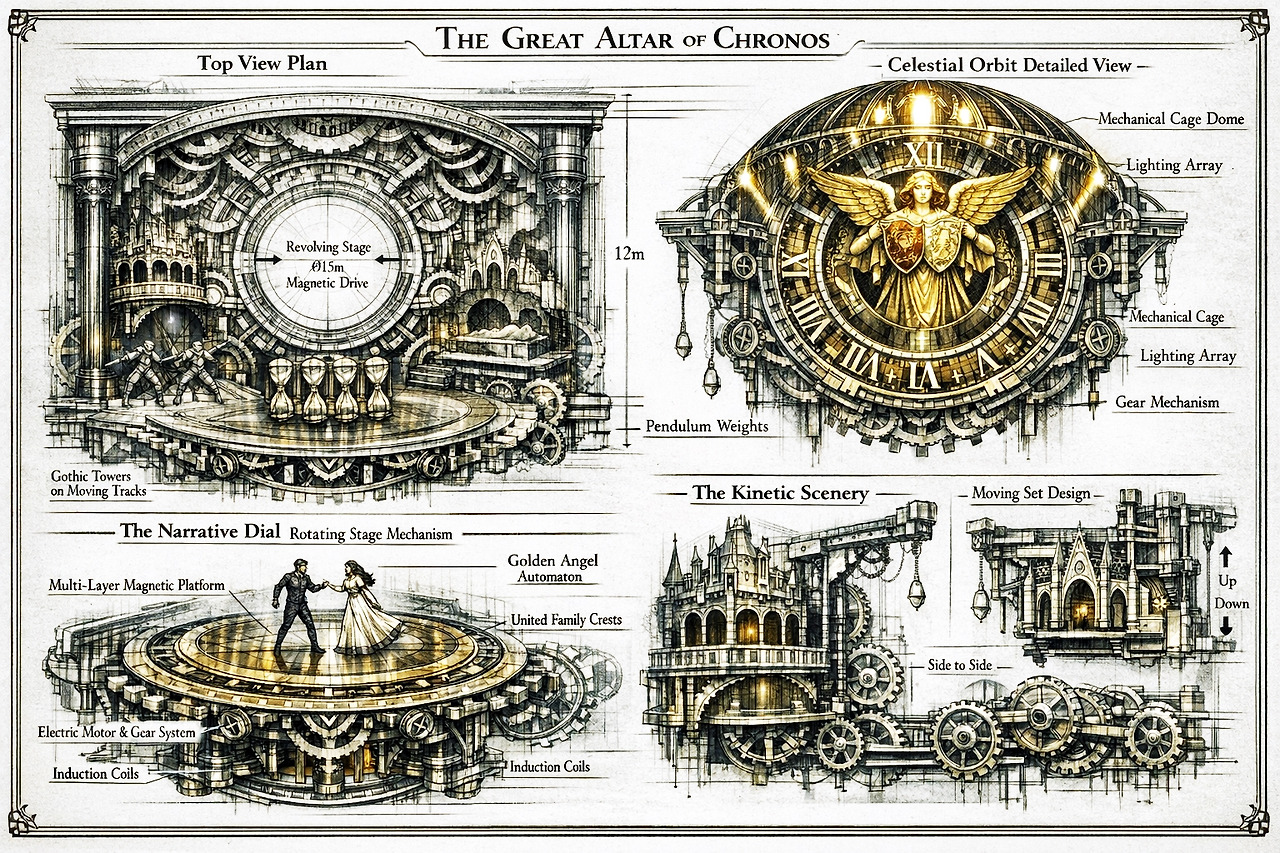
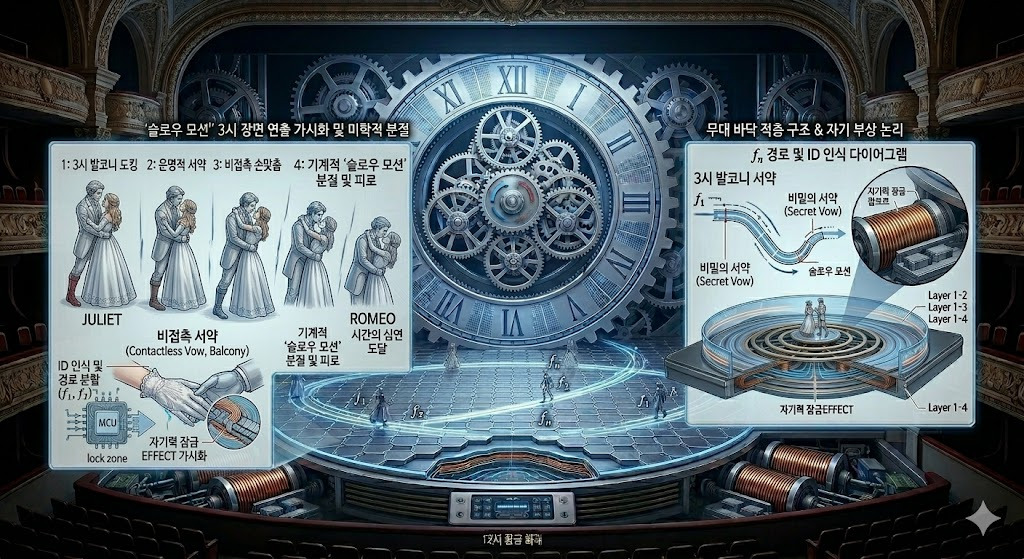
- 로미오와 줄리엣 오토마타 무대 평면도, 이 제작도 도면은 <로미오와 줄리엣: 영원한 시간의 수레바퀴>의 무대 장치를 기술적으로 분석한 4개의 섹션으로 구성되어 있습니다:
- 1. 평면도 (Top View Plan)
• 중심에 직경 15m의 회전식 무대가 배치되어 있으며, 멀티 레이어 자기 구동판으로 설계됨.
• 좌측에는 기사들의 결투 세트, 우측에는 무덤과 납골당 세트.
• 무대 하단에는 시간의 흐름을 상징하는 유리관형 모래시계 장치가 배치됨.
• 배경에는 고딕 양식의 탑들이 기어 트랙을 따라 수평·수직으로 이동.
- 2. 상부 구조 (Celestial Orbit Detailed View)
• 12 시방향 돔케이지 안에 황금 천사 오토마타가 배치되며, 두 가문의 문장을 합친 상징물을 들고 있음.
• 조명 어레이와 기어 메커니즘이 천사 주변을 둘러싸며, 펜듈럼 무게추가 아래에 위치.
- 3. 회전 무대 메커니즘 (The Narrative Dial Mechanism)
• 단면도로 표현된 회전 무대 내부에는 전기 모터, 기어 시스템, 유압 리프트가 배치됨.
• 배우와 오토마타가 혼용된 인형들이 자기장 기반으로 부유하듯 움직이며, 로미오와 줄리엣 인형이 손을 맞잡는 장면이 중심에 위치.
- 4. 배경 세트 이동 장치 (The Kinetic Scenery)
• 고딕 성 구조물이 수직 리프트 트랙과 수평 기어 암에 의해 이동.
• 장면 전환 시 기어 동기화 시스템을 통해 배경이 유기적으로 변화.
이 도면은 무대 제작자, 조명 디자이너, 기계 엔지니어, 연출가 모두에게 기술적·미학적 기준점을 제공하며, 오토마타 시계라는 컨셉을 실제 공연 공간에 구현하는 데 핵심적인 역할을 합니다.
Step 1: Linguistic Data Mining of unconscious language structure
Concept: implant Lacan's proposition that "inconsciousness is structured like language" into the automation process.
Perform: Large language models (LLMs) collect worldwide aesthetic language and user-lacked desire data for a particular family (e.g., cars, robots).
Results: We extract the 'signifiers' of the design to identify the flow of unconscious context, not logical algorithms.
- Romeo and Juliet Automata Stage Plan, this production drawing consists of four sections with a technical analysis of the staging of Romeo and Juliet: The Wheel of Eternal Time:
- 1. Plan (Top View Plan)
• A rotating stage with a diameter of 15 m is located in the center and is designed as a multi-layer magnetic drive panel.
• Duel sets of knights on the left, tomb and perilla set on the right.
• At the bottom of the stage, a glass tube-shaped hourglass device is placed to symbolize the passage of time.
• In the background, Gothic towers move horizontally and vertically along the gear track.
- 2. 상부 구조 (Celestial Orbit Detailed View)
• A golden angel automata is placed inside the dome cage at 12 o'clock, holding a symbol combining the sentences of the two families.
• A light array and gear mechanism surrounds the angel, with a pendulum weight positioned below.
- 3. The Narrative Dial Mechanism
• An electric motor, a gear system, and a hydraulic lift are placed inside the rotating stage as illustrated in a sectional view.
• The dolls mixed with actors and automata move as if floating on a magnetic field basis, with Romeo and Juliet holding hands at the center.
- 4. Background Set Mobility (The Kinetic Scenery)
• Gothic castle structure moved by vertical lift track and horizontal gear arm.
• The background changes organically through the gear synchronization system during scene transitions.
The drawings provide technical and aesthetic reference points for stage makers, lighting designers, mechanical engineers, and directors alike, and play a key role in implementing the concept of an automata clock in a real performance space.
Choi Chul-joo Pop-Art AAS Realism Product Design drawing《움직이는 사랑의 인형 시계》-8-로미오와 줄리엣 오토마타 무대 평면도
2단계: 상징적 결여를 통한 개념추상 스케치 (Abstract Application Sketch)
개념: 추상적용 스케치의 완벽한 데이터 사이에서 발생하는 ‘상징적 결여’를 의도적으로 포착합니다.
수행: AAS (Abstract Application Sketch)시스템이 완벽한 대칭을 제안할 때, 최철주의 ‘개념추상’ 필터를 적용하여 불필요한 장식을 거세하고 본질적인 비대칭성과 공간적 빈틈을 생성합니다.
결과: 제품의 기능적 핵심만을 남긴 채, 사용자가 자신의 욕망을 투사할 수 있는 ‘유령적 실루엣’을 도출한다.
- 무대 구성 요소
시간의 거대한 제단 오페라 무대 제작 제작도 메인 컨셉: "시간의 거대한 제단 (The Great Altar of Chronos)" 전형적인 '프로시니엄(Proscenium)' 아치 구조를 활용하되, 무대 전체를 하나의 거대한 시계 내부 기계 장치처럼 디자인합니다. 관객은 오페라하우스의 벨 에포크 양식과 대비되는 차갑고 정교한 티타늄/스틸 소재의 기계 미학을 목격하게 됩니다.
Step 2: Abstract Application Sketch Through Symbolic Lack
Concept: Intentionally captures the 'symbolic lack' that occurs between perfect data in abstract application sketches.
Perform: When the Abstract Application Sketch (AAS) system proposes perfect symmetry, Choi applies the 'conceptual abstract' filter to castrate unnecessary decorations and create intrinsic asymmetry and spatial gaps.
The result: It derives a "ghost silhouette" that allows users to project their desires, leaving only the functional core of the product.
- Stage components
The Great Altar Of Time Opera stage production is also the main concept: "The Great Altar of Chronos." Utilizing a typical "Proscenium" arch, the entire stage is designed like a giant clockwork. The audience will witness a cold, elaborate titanium/steel mechanical aesthetic that contrasts with the opera house's Bell Epoch style.
Choi Chul-joo Pop-Art AAS Realism Product Design drawing《움직이는 사랑의 인형 시계》-9-거대 수직 시계판 무대 장면
3단계: 환각(Hallucination)의 사건 콘티 구성 (Event Continuity Construction)
개념: AI의 오류인 환각 현상을 디자인의 창의적 ‘사건’으로 재구성합니다.
수행: AI가 물리 법칙을 무시하고 생성한 환각적 도면을 ‘만화적 이미지’의 콘티로 변환합니다. 이는 실재(The Real)에 도달하기 위한 시각적 가교 역할을 합니다.
결과: 비현실적이지만 강렬한 에너지를 가진 제품의 핵심 조형(Point of Focus)이 확립됩니다.
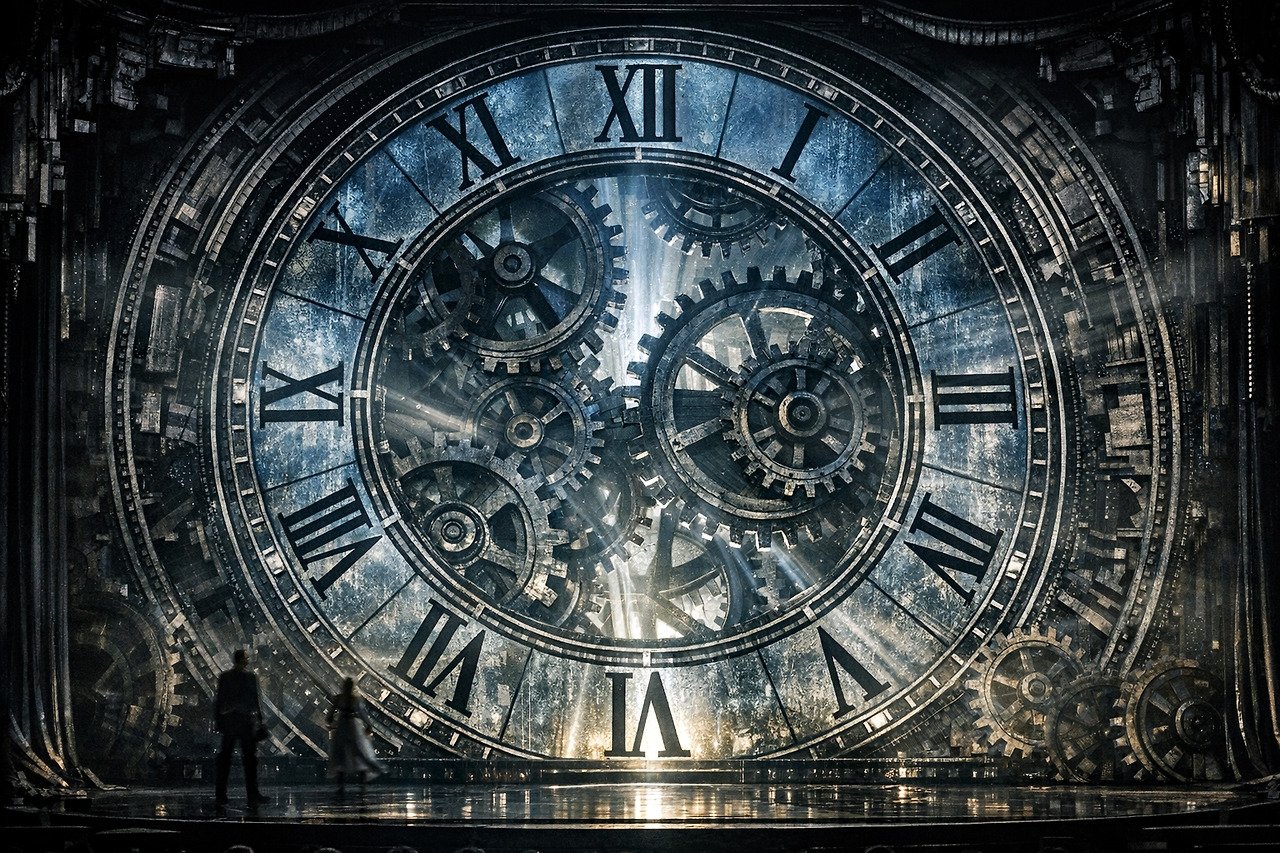
- 무대 장치 디자인 핵심 컨셉: "시간의 기계적 제단"
1. 거대 수직 시계판 (The Vertical Dial Backdrop)
무대 후면 전체를 직경 20미터의 거대한 시계 문자판이 차지합니다.
• 재질: 티타늄 프레임과 반투명 사파이어 글래스 레이어.
• 연출: 시계 숫자판 사이로 거대한 기어들이 맞물려 돌아가는 모습이 보이며, 매 시 정각(막의 전환)마다 기어 내부에서 강력한 백라이트가 뿜어져 나와 무대를 압도합니다.
• 오차의 미학: 최철주 평론가의 관점을 반영하여, 특정 장면에서 기어가 의도적으로 불규칙하게 멈추거나 역회전하며 운명의 뒤틀림을 시각화합니다.
• 이 이미지는 <로미오와 줄리엣: 영원한 시간의 수레바퀴>의 무대 후면을 차지하는 **거대 수직 시계판(The Vertical Dial Backdrop)**을 시각화한 것입니다:
2. 무대 후면 구조
• 직경 20미터의 시계 문자판이 무대 전체를 압도하며, 티타늄 프레임과 반투명 사파이어 글래스로 구성되어 있습니다.
• 문자판에는 로마 숫자 I~XII가 배치되어 있으며, 그 사이로 거대한 기어들이 맞물려 돌아가는 모습이 반투명 유리를 통해 드러납니다.
3. 조명 연출
• 매 시 정각마다 기어 내부에서 강력한 백라이트가 뿜어져 나와, 무대를 서사적으로 전환시키는 장면 전환 장치로 작동합니다.
• 조명은 차가운 백색광과 보랏빛 심연이 교차하며, 죽음과 시간의 미학을 강조합니다.
4. 오차의 미학
• 특정 장면에서는 기어가 불규칙하게 멈추거나 역회전하며, 최철주 평론가의 ‘오차의 미학’을 시각적으로 구현합니다.
• 이는 운명의 뒤틀림, 시간의 비선형성, 인간 욕망의 불완전성을 기계적 현상으로 치환한 연출입니다.
• 이 시계판은 단순한 배경이 아니라, 서사의 중심축이자 시간의 상징적 장치로 기능하며, 관객은 그 회전과 오차 속에서 비극의 리듬을 체험하게 됩니다.
Step 3: Hallucination's Event Continuity Construction
Concept: Reorganize hallucinations, an error in AI, as creative 'events' of design.
Perform: Translate hallucinatory drawings generated by AI in defiance of the laws of physics into conti in 'comic images' This serves as a visual bridge to reach The Real.
The result: A point of focus is established for products with unrealistic but intense energy.
- Stage Design Core Concept: "The Mechanical Altar of Time"
1. The Vertical Dial Backdrop
The entire back of the stage is occupied by a huge clock dial with a diameter of 20 meters.
• Material: titanium frame and translucent sapphire glass layer.
• Directed by: Huge gears can be seen interlocking through the clock number plates, with powerful backlighting emanating from the inside of the gears at every sharp turn (the transition of the act) to overwhelm the stage.
• Aesthetics of Error: Reflecting the perspective of critic Choi Cheol-joo, the gears intentionally stop or reverse in certain scenes, visualizing the twist of fate.
• This image is a visualization of the **Vertical Dial Backdrop** that takes over the back of the stage in Romeo and Juliet: The Wheel of Eternal Time:
2. Backstage Structure
• A 20-meter-diameter clock dial overwhelms the entire stage, consisting of a titanium frame and translucent sapphire glass.
• Roman numerals I to XII are placed on the dial, and the giant gears are engaged and turned through translucent glass.
3. lighting production
• A powerful backlight gushes from inside the gear every hour, acting as a scene-switching device that transforms the stage into an epic one.
• The lights are interlaced with cold white light and purple abyss, highlighting the aesthetics of death and time.
4. the aesthetics of error
• In certain scenes, the gears stop or reverse irregularly, visually embodying critic Choi Chul-joo's "Aesthetics of Error."
• This is a production that replaces the distortion of fate, the nonlinearity of time, and the imperfections of human desire with mechanical phenomena.
• This clock plate is not just a background, but functions as a central axis of the narrative and a symbolic device of time, and the audience experiences the rhythm of tragedy in its rotation and error.

Choi Chul-joo Pop-Art AAS Realism Product Design drawing《움직이는 사랑의 인형 시계》-10 -자기 부상 플로팅 무대 장면
4단계: 디지털 대타자의 파놉티콘 설계 (Digital Big Other Integration)
개념: 사회적 규범과 감시 체계(대타자)를 제품의 인터페이스에 통합합니다.
수행: 센서 및 디스플레이 레이아웃을 ‘응시(Gaze)’의 관점에서 재설계합니다. 제품이 사용자를 단순히 보조하는 것이 아니라, 상징적 권위를 가진 존재로서 상호작용하도록 자동화합니다.
결과: 디지털 파놉티콘의 시각적 질서가 반영된 인터페이스와 외부 센서 유닛 설계. 즉 의자의 등받이 중앙에 뚫려 있는 '공백(Void)' 부분이 극적으로 부각된다. 비어있는 원형 공간 뒤로 희미하게 인간의 그림자가 비친다. 이 '비어있음'이 역설적으로 강렬한 존재감을 드러낸다.
- 자기 부상 플로팅 무대 (Magnetic Levitation Stage Floor)
- 무대 바닥은 단순한 판이 아닌, 앞서 설계한 '멀티 레이어 자기 구동층'의 거대 확장판입니다.
• 플로팅 무브먼트: 배우들이 신은 특수 자기 슈즈와 무대 바닥의 인덕션 코일이 상응하여, 배우들은 물리적 걸음걸이가 아닌 미끄러지듯 유영하는 '비접촉 이동'을 선보입니다.
• 동적 궤적: 2시 무도회 장면이나 9시 추방 장면에서 인형(배우)들이 정해진 알고리즘에 따라 복잡한 곡선 궤적을 그리며 교차합니다.
• 이 이미지는 <로미오와 줄리엣: 영원한 시간의 수레바퀴>의 핵심 기술 장치인 **자기 부상 플로팅 무대(Magnetic Levitation Stage Floor)**를 시각화한 것입니다:
- 무대 바닥 구조
• 바닥은 멀티 레이어 자기 구동층으로 구성되어 있으며, 중심부에는 푸른빛으로 빛나는 동심원 패턴이 펼쳐져 있습니다.
• 배우들은 자기 제어 슈즈를 착용하고, 무대 하단의 인덕션 코일과 상호작용하여 물리적 접촉 없이 미끄러지듯 유영합니다.
- 장면 연출
• 좌측에는 어두운 복장의 남성(로미오)이, 우측에는 무도회 드레스를 입은 여성(줄리엣)이 서로를 향해 부드럽게 이동하며, 빛의 궤적이 곡선으로 교차합니다.
• 배경 좌측에는 가면무도회 장면, 우측에는 추방과 폐허의 이미지가 흐릿하게 배치되어, 2시와 9시 장면을 동시에 암시합니다.
- 알고리즘 기반 궤적
• 배우들의 이동은 단순한 직선이 아닌, 복잡한 곡선 궤적으로 설계되어 있으며, 이는 알고리즘 기반의 동적 시퀀스로 작동합니다.
• 빛의 궤적은 무대 위에 시계의 초침처럼 유기적으로 교차하며, 시간과 욕망의 흐름을 시각화합니다.
• 이 무대는 단순한 기술적 장치가 아니라, 시간·공간·감정이 교차하는 서사적 플랫폼으로 기능하며, 관객은 배우의 유영을 통해 운명적 비접촉의 미학을 체험하게 됩니다.
Step 4: Digital Big Other Integration
Concept: Integrate social norms and surveillance systems (batters) into the product's interface.
Perform: redesign the sensor and display layout from a 'gaze' perspective. Automate the product to interact with you as an iconic authority, not just as an assistant.
Results: Designing an interface and external sensor unit reflecting the visual order of the digital panopticone.
- Magnetic Levitation Stage Floor
- The stage floor is not just a plate, but a giant extension of the 'multi-layer self-driving layer' designed earlier.
• Floating Movement: The actors' special magnetic shoes and induction coils on the floor of the stage correspond, so the actors perform a 'contactless movement' in which they glide and swim rather than a physical walk.
• Dynamic Trajectory: In a 2 o'clock ball scene or a 9 o'clock deportation scene, dolls (actors) cross by drawing complex curved trajectories according to a set algorithm.
• This image is a visualization of the **Magnetic Levitation Stage Floor**, a key technology device in Romeo and Juliet: The Wheel of Eternal Time:
- the floor structure of a stage
• The floor consists of a multi-layer self-driving layer, with a concentric pattern in the center that shines blue.
• Actors wear magnetic control shoes and interact with the induction coil at the bottom of the stage to glide and swim without physical contact.
- scene production
• On the left is a dark-dressed man (Romeo) and on the right is a woman (Juliet) in a ball dress (Juliet) moving gently towards each other, with the trajectory of light crossing in a curve.
• Scenes from the masquerade on the left side of the background and images of deportation and ruins on the right side are blurred, suggesting scenes at 2 and 9 at the same time.
- algorithm-based trajectory
• The actors' movements are designed with complex curved trajectories, not just straight lines, which operate as algorithm-based dynamic sequences.
• The trajectory of light intersects organically like the second hand of a clock on stage, visualizing the flow of time and desire.
• This stage is not just a technical device, but functions as an epic platform where time, space, and emotions intersect, and the audience experiences the aesthetics of a fateful non-contact through the actor's swimming.
Choi Chul-joo Pop-Art AAS Realism Product Design drawing《움직이는 사랑의 인형 시계》-11 - 입체적 돌출 발코니와 무덤 무대 장면
5단계: 거울 단계의 나르시시즘 구현 (Mirror Stage Materialization)
개념: 사용자가 제품에서 자신의 이상적 자아를 발견하도록 유도합니다.
수행: AI가 사용자의 심리적 피드백을 실시간으로 학습하여 제품의 질감, 광택, 라이팅을 미세하게 조정(Automation Tuning)합니다.
결과: 사용자가 AI를 ‘또 다른 나’로 착각하게 만드는 나르시시즘적 결합력을 가진 최종 마감 완성.
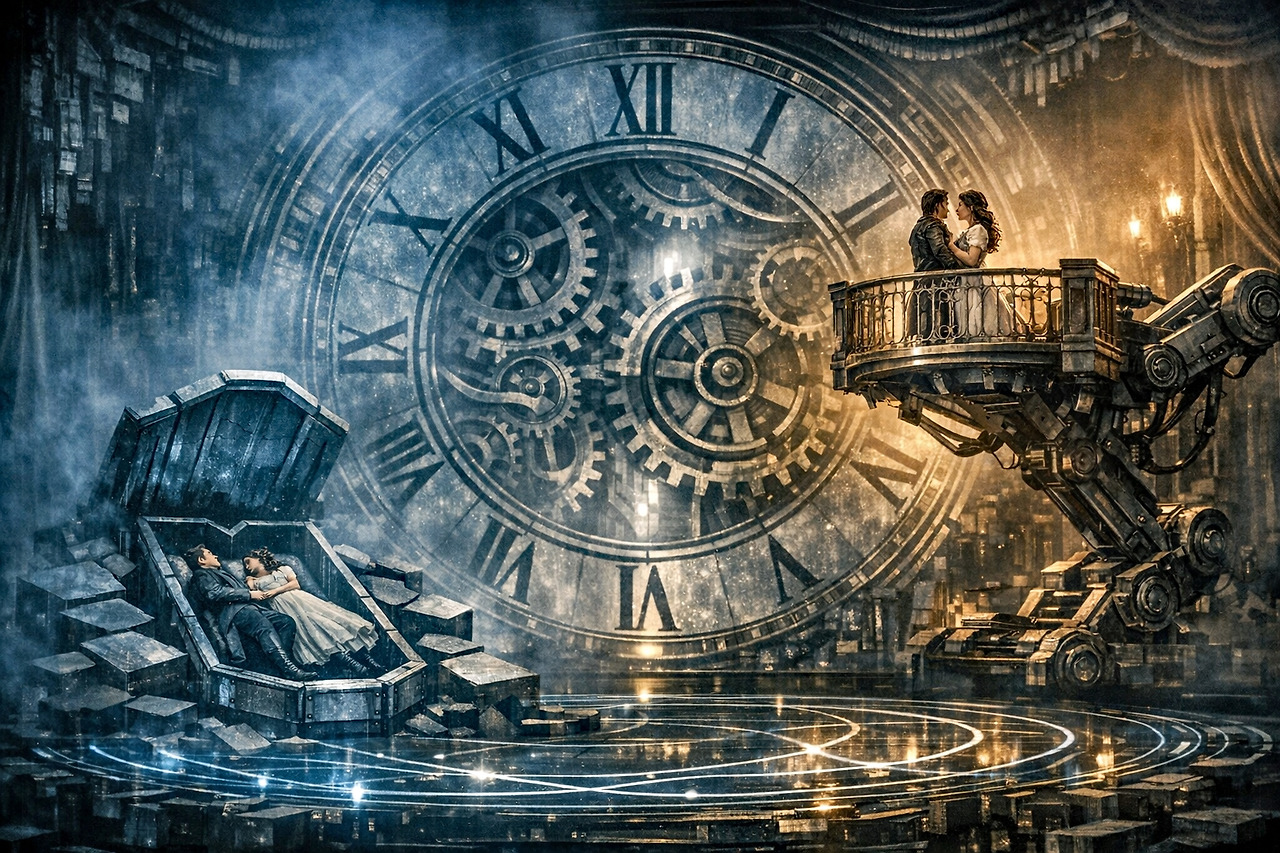
- 입체적 돌출 발코니와 무덤 (Kinetic Scenery Units)
• 3시 발코니: 시계 중심부(9시와 3시 방향)에서 거대한 기계 팔이 튀어나와 공중에 발코니 형태의 플랫폼을 형성합니다.
• 10시 무덤: 무대 중앙 바닥이 육각형 격자 형태로 열리며, 지하의 제어 유닛(MCU) 층이 차가운 금속성 무덤으로 변모하여 상승합니다.
• 장면 디테일 일러스트가 완성되었습니다.
• 이 이미지는 <로미오와 줄리엣: 영원한 시간의 수레바퀴>의 서사적 핵심 요소인 **입체적 돌출 발코니와 무덤(Kinetic Scenery Units)**을 시각화한 것입니다:
- 3시 발코니 (발코니 씬)
우측에는 기계 팔(Mechanical Arm)에 의해 공중으로 튀어나온 발코니 플랫폼이 형성되었습니다.
• 발코니에는 두 인형(혹은 배우)이 로맨틱하게 마주 서 있으며, 무대 중심부에서 3시 방향으로 돌출된 구조입니다.
• 배경은 고딕 양식의 베로나 건축과 시계 기어가 어우러져, 사랑의 고양된 순간을 기계적 미학으로 포착합니다.
- 10시 무덤 (무덤 씬)
• 좌측에는 무대 중앙 바닥이 육각형 격자로 열리며 솟아오른 차가운 금속 무덤이 위치합니다.
• 무덤 내부에는 두 연인의 시신이 안치되어 있으며, 무덤을 둘러싼 분위기는 차갑고 장엄합니다.
• 무대 하부의 MCU 제어 유닛이 무덤으로 변모하며, 기계적 완결성과 비극적 종결을 동시에 상징합니다.
- 무대 연출
• 배경에는 거대한 시계 기계 장치가 어두운 안개 속에 드러나 있으며, 무대는 비극과 로맨스가 동시에 펼쳐집니다.
• 조명은 발코니는 따뜻하고 밝게, 무덤은 차갑고 어둡게 대비시켜, 운명의 두 갈래 길을 극명하게 보여줍니다.
• 이 장면은 공간 이동과 비극적 서사의 정수인 발코니의 사랑과 무덤의 죽음을 동시에 시각화하며, 관객에게 운명적 대조와 감정의 클라이맥스를 강렬하게 전달합니다.
Step 5: Mirror Stage Materialization
Concept: Encourage users to discover their ideal self in the product.
Perform: AI learns the user's psychological feedback in real time to fine-tune the texture, gloss, and lighting of the product.
Result: Final finish with narcissistic bonding that makes users mistake AI for 'another me'.
- Three-dimensional protruding balconies and tombs
• 3 o'clock Balcony: A huge mechanical arm pops out of the center of the clock (9 and 3 o'clock directions) to form a balcony-type platform in the air.
• Ten o'clock Grave: The central floor of the stage opens into a hexagonal grid, and the underground control unit (MCU) layer is elevated by the transformation into a cold metallic grave.
• The scene detail illustration is complete.
• This image is a visualization of the narrative core element of Romeo and Juliet: The Wheel of Eternal Time: **Dimensional Protruding Balconies and Graves**:
- 3 p.m. Balcony scene
On the right, a balcony platform protruding into the air by a mechanical arm was formed.
• On the balcony, two dolls (or actors) are standing romantically opposite each other, and they protrude from the center of the stage in the direction of three o'clock.
• The background combines Gothic Verona architecture with clock gear to capture the elevated moments of love with mechanical aesthetics.
- Ten o'clock Tomb (The Tomb Scene)
• To the left is a cold metal grave that rises, with the center floor of the stage opening into a hexagonal grid.
• Inside the tomb lies the bodies of two lovers, and the atmosphere surrounding the tomb is cold and majestic.
• The MCU control unit at the bottom of the stage is transformed into a tomb, symbolizing both mechanical integrity and tragic termination.
- stage production
• In the background, a huge clockwork is exposed in a dark fog, and the stage unfolds both tragedy and romance.
• The lights contrast the balconies warm and bright and the graves cold and dark, clearly showing the two-pronged paths of fate.
• The scene simultaneously visualizes the love of the balcony and the death of the grave, the essence of space movement and tragic narratives, and delivers a powerful climax of fateful contrasts and emotions to the audience.
Choi Chul-joo Pop-Art AAS Realism Product Design drawing《움직이는 사랑의 인형 시계》-12-시간의 기계적 제단 무대 전체 조감도
6단계: 개념추상 리얼리즘의 실재 육화 (Incarnation of the Real)
개념: 추상적 개념을 견고한 물리적 실체로 변환합니다.
수행: 엔지니어링 최적화 단계에서 ‘만화적 선(Comic-book lines)’의 선명도를 유지하며 3D 프린팅 및 정밀 가공 프로세스를 자동화합니다.
결과: 실재 제품으로 탄생한 ‘개념추상 리얼리즘’ 오브제.
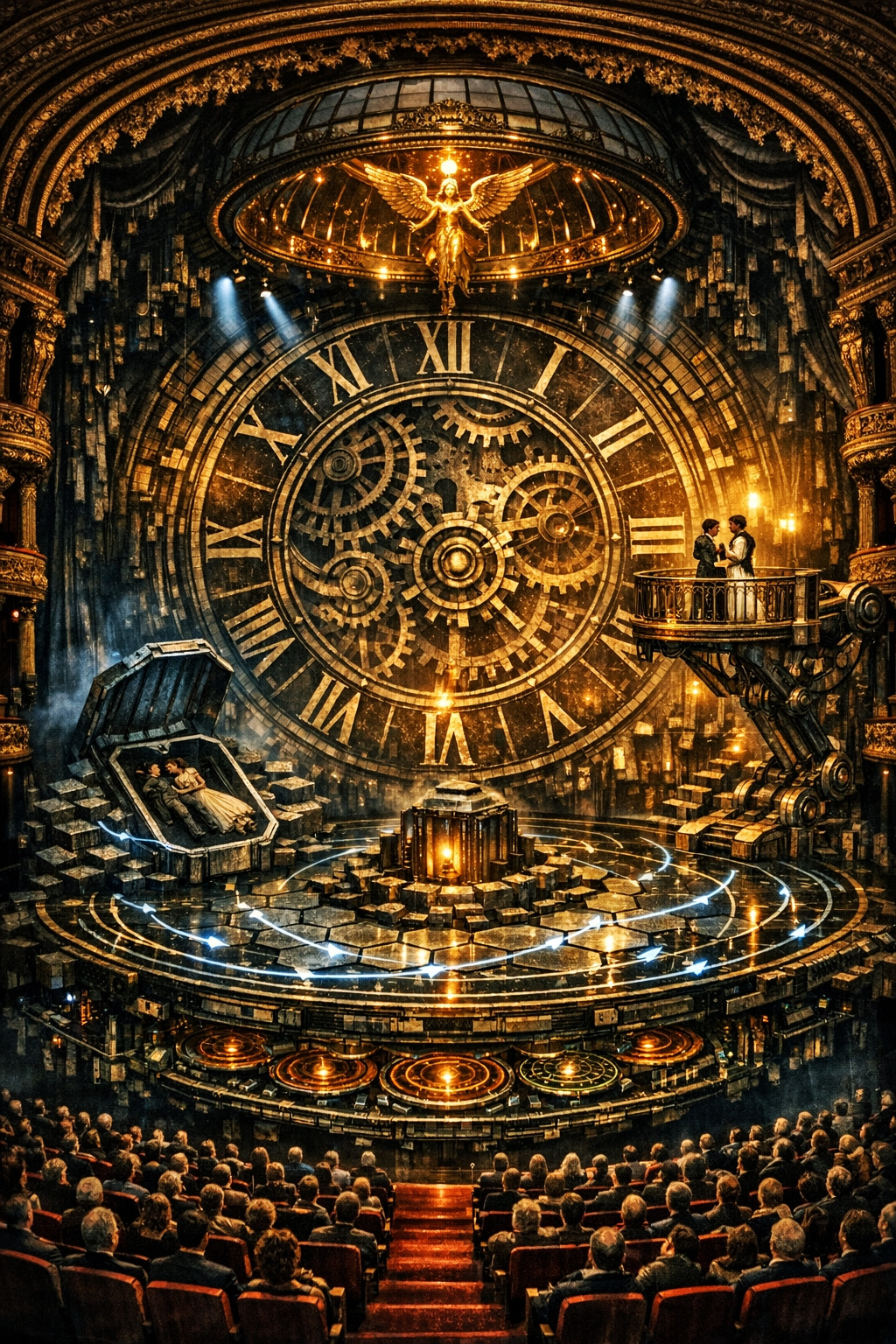
- 무대 전체 조감도: 시간의 기계적 제단 (The Great Altar of Chronos)
이 스케치는 프랑스 오페라하우스 극장의 프로시니엄(Proscenium) 아치 안에 거대한 시계 내부 장치가 들어선 모습을 보여줍니다. 관객석에서 바라본 전경입니다.
• 메인 기어 백드롭 (The Clockwork Backdrop): 무대 후면 전체를 직경 20미터의 티타늄 기어들이 차지합니다. 12개의 숫자판(Roman Numerals) 사이에 태양광 패널 패턴이 미세하게 스케치되어 있습니다.
• 플로팅 무대 바닥 (The Floating Floor): 바닥은 육각형 격자 형태로 나뉘어 있으며, 하단에는 '자기 구동 코일'과 '홀 센서' 배열이 적층된 단면이 스케치되어 있습니다. 배우들이 물리적인 발걸음 없이 무대 위를 미끄러지듯 유영하는 동선을 화살표로 표현했습니다.
• 수직 레이어 구조: 무대 상부(Celestial Orbit)에는 황금 천사가 대기하는 돔이, 무대 중앙 지하(The Tomb/MCU Layer)는 무덤 장면에서 상승하는 구조로 표현되어 입체적인 공간 활용을 보여줍니다.
• 무대 전체 조감도 “시간의 기계적 제단(The Great Altar of Chronos)”이 완성되었습니다.
• 이 이미지는 프랑스 오페라하우스의 프로시니엄 아치 안에 거대한 시계 내부 장치가 들어선 모습을 관객석에서 바라본 시점으로 구성되어 있습니다.
- 무대 구성 요소
• 메인 기어 백드롭: 무대 후면 전체를 직경 20미터의 티타늄 기어들이 차지하며, 로마 숫자판 사이에는 태양광 패널 패턴이 미세하게 삽입되어 있습니다.
• 플로팅 무대 바닥: 육각형 격자 형태로 나뉜 바닥 아래에는 자기 구동 코일과 홀 센서 배열이 적층되어 있으며, 배우들의 유영 궤적이 푸른빛 화살표로 표현되어 있습니다.
• 수직 레이어 구조: 상부에는 황금 천사가 대기하는 돔이, 하부에는 무덤 장면에서 상승하는 MCU 제어 유닛이 배치되어 입체적 공간 활용을 보여줍니다.
• 이 조감도는 무대 전체를 하나의 시간 기계로 설정하여, 관객이 서사적 흐름을 기계적 구조와 조명, 공간 이동을 통해 직관적으로 체험할 수 있도록 설계되었습니다.
"움직이는 사랑의 인형 시계(Automata Love Clock)" 무대장치를 구현하기 위한 거대 조감도: 시간의 기계적 제단 (The Great Altar of Chronos)의 아이디어 연필 스케치 드로잉입니다.
• 이 스케치는 기계적 미학(Mechanical Aesthetics)과 서사적 조형물(Narrative Structure)을 결합하여, 셰익스피어의 비극을 현대적 개념 추상 평론가 최철주의 시각으로 재해석하는 무대 공간의 뼈대를 보여줍니다.
Step 6: The Incarnation of the Real of Concept Abstract Realism
Concept: Transforming abstract concepts into solid physical reality.
Perform: Automate 3D printing and precision processing while maintaining 'Comic-book lines' clarity during the engineering optimization phase.
The result: The 'conceptual abstract realism' object created as a real product.
- A bird's eye view of the whole stage: The Great Altar of Chronos
The sketch shows a huge device inside the French opera house's proscenium arch. This is a panoramic view from the audience.
• The Clockwork Backdrop: Titanium gears with a diameter of 20 m occupy the entire back of the stage. Solar panel patterns are finely sketched between 12 Roman numerals.
• The Floating Floor: The floor is divided into hexagonal grids, and at the bottom is sketched a cross-section with a stack of "magnetic driving coils" and "hall sensors." The actors' movements as they glide on the stage without physical steps are depicted with arrows.
• Vertical Layer Structure: The Celestial Orbit has a dome with a golden angel waiting, and The Tomb/MCU Layer is represented in an ascending structure in the tomb scene, showing three-dimensional space utilization.
• The entire view of the stage was also completed with "The Great Altar of Chronos."
• This image consists of a view from the audience as a huge internal device of the clock is built inside the proscenium arch of the French opera house.
- Stage components
• Main Gear Backdrop: Titanium gears with a diameter of 20 meters occupy the entire back of the stage, with a solar panel pattern inserted finely between Roman number plates.
• Floating Stage Floor: Below the floor, divided into hexagonal grating forms, is a stacked array of magnetic drive coils and hall sensors, with actors' swimming trajectories represented by blue arrows.
• Vertical layer structure: a dome with a golden angel waiting at the top and an MCU control unit rising from the tomb scene at the bottom to show three-dimensional space utilization.
• This bird's-eye view is designed to set the entire stage as a time machine, allowing the audience to intuitively experience the narrative flow through mechanical structure, lighting, and space movement.
An idea pencil sketch drawing from The Great Altar of Chronos to embody the "Automata Love Clock" staging.
• The sketch combines mechanical aesthetics with narrative structures to show the framework of the stage space that reinterprets Shakespeare's tragedy from the perspective of modern conceptual abstract critic Choi Chul-joo.
Choi Chul-joo Pop-Art AAS Realism Product Design drawing《움직이는 사랑의 인형 시계》-13-플로팅 도킹(Floating Docking)-1
- 통합 시그널 디자인: 집단적 오로라 (The Collective Aurora)
운전석과 수백 개의 좌석에서 수집된 욕망 시그널(V cdot Delta)이 열차 내부의 전체 조명 시스템과 통합되어 거대한 '집단적 무의식의 가상 생태계'를 형성합니다.
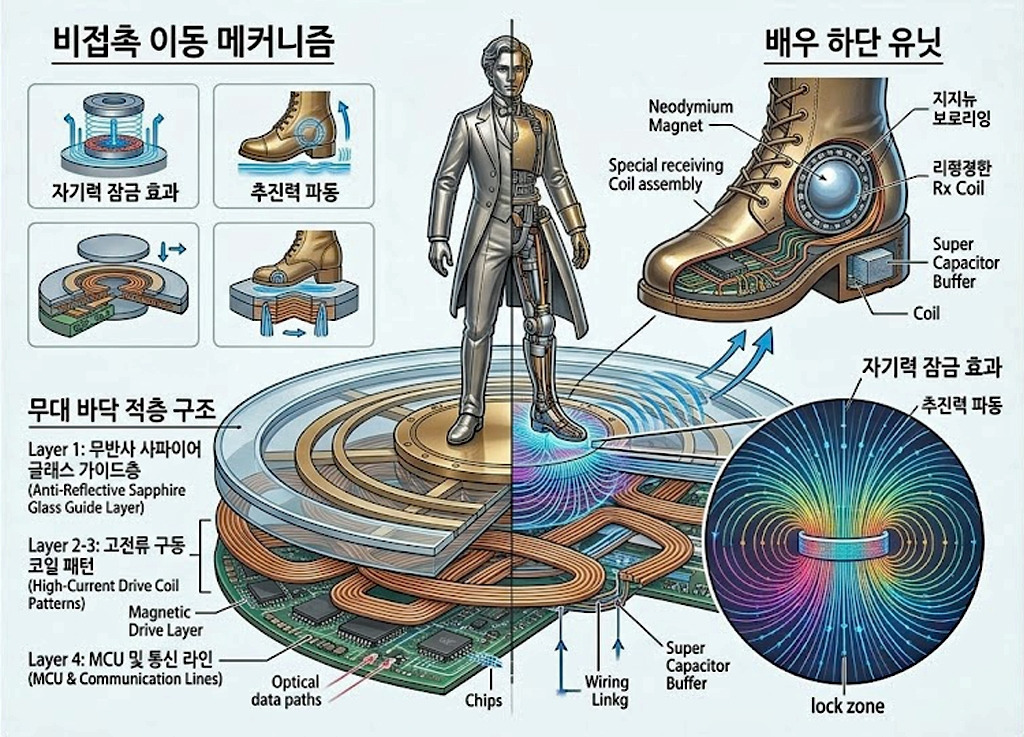
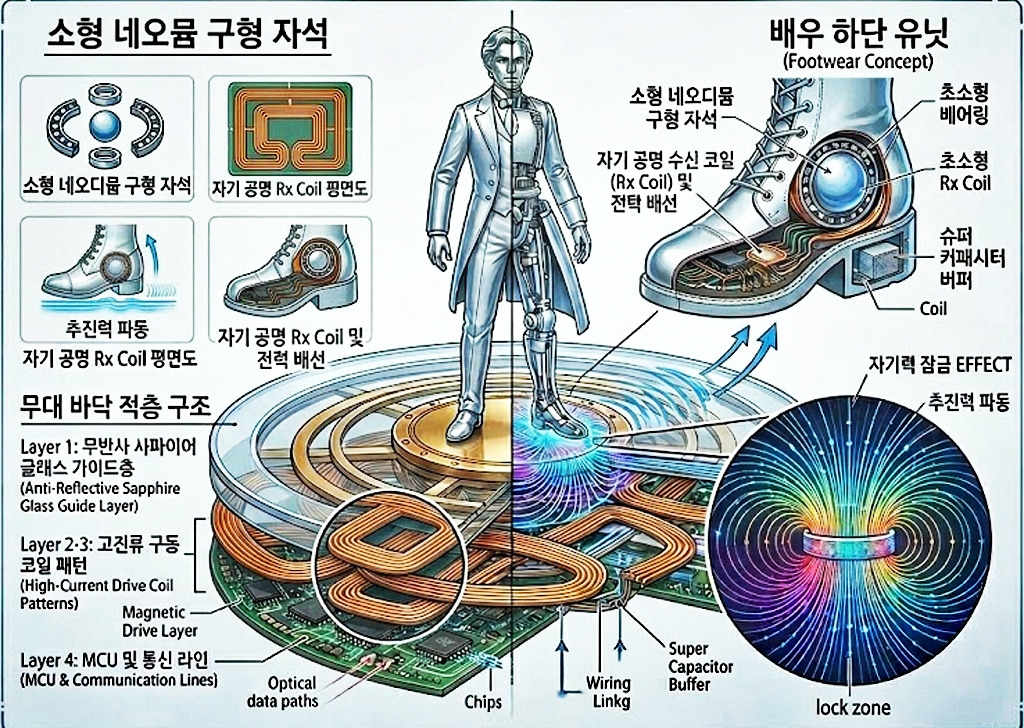
- 핵심 메커니즘 상세도: '플로팅 도킹(Floating Docking)' 및 자기 부상 기술
이 스케치는 배우들이 무대 위를 비접촉 이동(Contactless Movement)하게 만드는 핵심 결합 방식인 '플로팅 도킹(Floating Docking)' 시스템의 상세 설계도입니다.
• 배우 하단 유닛 (Footwear Concept): 배우가 신은 슈즈 단면을 스케치했습니다. 발바닥 내부에는 소형 네오디뮴 구형 자석과 초소형 베어링이 내장되어 있습니다. 슈즈 하단에서 '자기 공명 수신 코일(Rx Coil)'과 '슈퍼 커패시터 버퍼'로 연결되는 무선 전력 전송 배선이 스케치되어 있습니다.
• 무대 바닥 적층 구조: 무대 바닥은 '무반사 사파이어 글래스 가이드층(Layer 1)', '고전류 구동 코일 패턴(Layer Magnetic Drive Layer)', 'MCU 및 통신 라인(Layer 4)'으로 적층된 단면을 렌더링했습니다. 코일이 활성화될 때 발생하는 '자기력 잠금(Magnetic Locking)'과 추진력의 파동(Flux lines)을 시각화했습니다.
- Integrated Signal Design: The Collective Aurora
Desire signals (Vcdot Delta) collected from the driver's seat and hundreds of seats are integrated with the entire lighting system inside the train to form a huge 'virtual ecosystem of collective unconsciousness'.
- Core Mechanism Details: 'Floating Docking' and Magnetic Injury Technology
This sketch is a detailed design of the Floating Docking system, a key combination method that makes actors move contactless on stage.
• Footwear Concept: Sketched a cross-section of shoes worn by the actor. Inside the soles of the feet are compact neodymium spherical magnets and ultra-small bearings. A wireless power transmission wiring from the bottom of the shoes to a "magnetic resonance receiving coil (Rx Coil)" and a "super capacitor buffer" is sketched.
• Stage Floor Stacking: The stage floor rendered a laminated section with 'Unreflective Sapphire Glass Guide Layer 1', 'Layer Magnetic Drive Layer', and 'MCU and Communication Line Layer 4'. We visualized the 'magnetic locking' and the flux lines of the propulsion that occur when the coil is activated.
Choi Chul-joo Pop-Art AAS Realism Product Design drawing《움직이는 사랑의 인형 시계》-14-플로팅 도킹(Floating Docking)-4
Choi Chul-joo’s concept of desire, en capsulated in the metaphor of “morning glory,” presents a radical departure from metaphysical linguistic traditions that emphasize meaning as a stable, referential structure. Instead, his work constructs a visual grammar of desire that foregrounds absence, insufficiency, and the temporality of longing. By generating dramatic event-images suffused with reversible shades of white light, Choi resists the materialist ontology of 18th-century painting, which sought to anchor meaning in physical perception and representation. His images do not depict desire as a fixed object but rather as a dynamic interplay of linguistic abstraction and visual temporality, where the grammatical structure of desire becomes a spatial principle—an architecture of insufficiency.
From a cognitive science perspective, this approach aligns with contemporary understandings of perception as a constructive, symbolic process. Choi’s use of superimposed temporal layers and reversible illumination reflects how the human mind processes absence—not as a void, but as a generative space shaped by the desire of the Other. This resonates with Lacanian psychoanalysis, which posits that desire is always mediated through the symbolic order and structured by the gaze of the Other, and with Freudian theory, which frames desire as a product of unconscious lack. In Choi’s work, the pond becomes a reflective surface—not merely of light, but of intersubjective longing—where the image of an event is not a representation but a manifestation of the desires that circulate beyond the self.
The dualistic nature of his visual grammar—where real images are treated as events and spatial composition mirrors the structure of desire—suggests a cognitive model in which perception is inseparable from symbolic mediation. The reversible light, unfolding over time, transforms material into image, and image into object, thereby collapsing the distinction between representation and event. In this way, Choi’s concept of abstract desire is not only a philosophical proposition but a cognitive experiment: a visual system that externalizes the internal logic of desire, revealing how the mind constructs reality through the absence of what it seeks.
Choi Chul-joo’s concept of desire, embodied in the metaphor of the “morning glory,” functions as a cognitive architecture that visualizes the structural absence inherent in human desire, transcending material perception and instead engaging with the linguistic and symbolic frameworks that shape subjective experience. His work resists the materialist tradition of 18th-century painting by rejecting direct representation and instead constructs layered event-images that reflect the temporality and reversibility of white light, thereby encoding desire not as a tangible object but as a spatial-temporal phenomenon mediated by language and abstraction. From a cognitive science perspective, this approach aligns with the understanding that human perception is not a passive reception of stimuli but an active construction shaped by symbolic systems and intersubjective desire. Choi’s use of reversible light and superimposed spatial structures mirrors the way the mind processes absence—not as a void, but as a generative space where the desire of the Other is internalized and reprojected. This resonates with Lacan’s notion that desire is always the desire of the Other, and with Freud’s view that desire emerges from unconscious lack. The pond reflecting event-images becomes a metaphor for the cognitive mirror stage, where the subject forms its identity through the reflection of external desire, and the abstract grammar of desire becomes a dualistic object that equates real images with events, transforming material into symbolic cognition. Thus, Choi’s visual language becomes a cognitive map of how desire is structured, perceived, and reimagined—not through physicality, but through the interplay of light, absence, and linguistic meaning.

Choi Chul-joo Pop-Art AAS Realism Product Design drawing《움직이는 사랑의 인형 시계》-15-슬로우 모션
- 슬로우 모션' 장면 연출 상세 스케치: 8시 줄리엣의 비약
이 스케치는 최철주의 '오차의 미학(Aesthetics of Error)'을 극대화하기 위해, 인형(배우)이 비약을 마시고 쓰러지는 찰나를 기계적으로 분절하여 시각화하는 기술 상세도입니다.
• 댐퍼 시스템 (Dampening Mechanism): 줄리엣 인형(배우)의 흉부 내부에 '초소형 슈퍼 커패시터'와 'Internal Controller'가 배치된 투시도를 스케치했습니다. 이들은 외부 시스템의 간섭 없이 약 10초간 독립적인 구동을 가능하게 합니다.
• 시간 분절 연출: 줄리엣이 시계 바늘 위로 쓰러지는 순간, 인형 내부의 '압전 액추에이터(Micro-Joint Piezoelectric Actuators)'와 슬로우 모션 댐퍼가 작동하여, 움직임의 연속성을 인위적으로 끊어내는 '오차 없는 순수 추상'의 정지 상태를 단계별로 스케치했습니다.
- "Slow Motion" Scene production details sketch: Juliet's leaps and bounds at 8 o'clock
This sketch is a technical detail that mechanically segments and visualizes the moment a doll (actor) falls down after taking a leap to maximize Choi Chul-joo's "Aesthetics of Error."
• Damping Mechanism: We sketched a perspective view of Juliet's doll with a 'miniature supercapacitor' and an 'internal controller' placed inside the chest. They allow independent driving for about 10 seconds without interference from an external system.
• Time Segmentation: As soon as Juliet falls over the hands of a clock, Micro-Joint Piezoelectric Actuators and slow-motion dampers inside the doll are activated to sketch the stationary state of Pure Abstraction Without Error, which artificially breaks the continuity of movement.

Choi Chul-joo Pop-Art AAS Realism Product Design drawing《움직이는 사랑의 인형 시계》-16-거대 오르골
- 정적 기표의 파열: 글리치 미학 (Visual Rupture)
완벽하게 매끄러운 인터페이스는 오히려 공허함을 유발합니다. 사용자의 개입이나 감정적 변화가 발생할 때 의도적인 시각적 오류(Glitch)를 노출하여 시스템이 살아있음을 증명합니다.
- 거대 오르골' 사운드 아키텍처 스케치
이 스케치는 극장 전체에 실제 오르골 빗(Comb)을 튕기는 소리를 입체 음향으로 증폭하여 기계적 서사를 강조하는 사운드 시스템 상세도입니다.
• 오르골 사운드 모듈: 무대 좌우에 배치된 대형 구리판(Comb)을 기계식 실린더가 타격하는 모습을 스케치했습니다.
• 비올라 다 가바 선율과의 믹싱: 거대 오르골 소리와 실제 비올라 다 가바 선율이 MCU 제어 하에 기계적으로 연주되도록 설계된 초소형 오르골 내장 구조를 렌더링했습니다.
- Breaking Static Signs: Glitch Aesthetics
A perfectly smooth interface rather causes emptiness. When user intervention or emotional change occurs, it exposes intentional visual errors (Glitch) to prove that the system is alive.
- Sketch of 'Gigantic Orgel' Sound Architecture
This sketch is a sound system detail that highlights mechanical narratives by amplifying the sound of bouncing a real orb comb into stereophonic sounds throughout the theater.
• Orgel Sound Module: sketched a large copper plate (Comb) placed on the left and right sides of the stage by a mechanical cylinder.
• Mixing with Viola da gava melody: rendered a micro - organ built structure designed to allow the giant organ sound and actual viola da gava melody to be played mechanically under MCU control.
Choi Chul-joo’s application of the desire formula "D(I...I')d=I(D...D')i" to the image of “morning glory” constructs a symbolic landscape in which the flower floats in the sky, visually linking the abstract concept of desire with its aesthetic background. This formula operates as a cognitive and psychoanalytic mechanism, wherein the image of desire (I) is not merely a representation but a structural repetition of desire (D) across multiple visual instances (I...I'), which themselves reflect the recursive nature of desire (D...D'). In this framework, the “morning glory” becomes both the object and the medium through which desire is shaded, refracted, and rendered in reversible shadow structures—particularly when the object is configured as the feminine image of desire. The substitution of the formula within the artwork <morning glory> reveals a layered interplay between symbolic abstraction and visual cognition, where the image of artistic behavior or desire (I) emerges as the conceptual form of desire (i), thus collapsing the boundary between representation and structure. From a psychoanalytic perspective, this recursive logic mirrors Lacan’s notion that desire is constituted through the gaze of the Other and Freud’s view that desire is driven by unconscious repetition and symbolic substitution. Cognitively, the formula encodes how the mind processes desire not as a static object but as a dynamic system of mirrored images and temporal shadows, ultimately transforming abstract longing into a visual syntax of emotional architecture.

Choi Chul-joo Pop-Art AAS Realism Product Design drawing《움직이는 사랑의 인형 시계》-17-정적 기표의 파열 로미오와 줄리엣 영원한 시간의 수레바퀴 글리치 미학 (Visual Rupture)
[렌더링 핵심 디테일]
1. 데이터 왜곡(Datamoshing): 중앙의 HUD 인터페이스가 승객의 감정적 임계치를 넘어서는 순간, 형태가 액체처럼 뭉개지며 내부의 에너지를 강렬하게 분출합니다.
2. 픽셀 소트(Pixel Sorting) 효과: 화면 가장자리에서 시작된 픽셀의 수직 낙하는 시스템의 정적 질서를 깨뜨리고, 승객이 시스템에 개입하고 있다는 실존적 증거를 시각화합니다.
3. 톱니파(Sawtooth) 파열: 평온한 사인파(Sine Wave)가 날카로운 톱니파로 변화하며 화면을 찢고 나가는 연출은, '상징적 공허'를 뚫고 나오는 주체적 욕망의 소리를 시각적으로 대변합니다.
4. 색수차 및 글리치 광원: 마젠타와 바이올렛 톤의 색수차 효과가 겹쳐지며, 단순한 오류가 아닌 하나의 '찬란한 미학적 경험'으로서의 시스템 환경을 완성합니다.
["로미오와 줄리엣: 영원한 시간의 수레바퀴" 렌더링 핵심 디테일 ]
1. 데이터 왜곡(Datamoshing): 중앙의 HUD 인터페이스가 연극 <로미오와 줄리엣: 영원한 시간의 수레바퀴> 관객의 감정적 임계치를 넘어서는 순간, 형태가 액체처럼 뭉개지며 내부의 에너지를 강렬하게 분출합니다.
2. 픽셀 소트(Pixel Sorting) 효과: 화면 가장자리에서 시작된 픽셀의 수직 낙하는 시스템의 정적 질서를 깨뜨리고, 승객이 시스템에 개입하고 있다는 실존적 증거를 시각화합니다.
3. 톱니파(Sawtooth) 파열: 평온한 사인파(Sine Wave)가 날카로운 톱니파로 변화하며 화면을 찢고 나가는 연출은, '상징적 공허'를 뚫고 나오는 주체적 욕망의 소리를 시각적으로 대변합니다.
4. 색수차 및 글리치 광원: 마젠타와 바이올렛 톤의 색수차 효과가 겹쳐지며, 단순한 오류가 아닌 하나의 '찬란한 미학적 경험'으로서의 시스템 환경을 완성합니다.
- 이번 이미지는 사이버-초현실 글리치 아트 스타일로, 중앙 HUD 인터페이스가 액체처럼 붕괴하며 강렬한 에너지를 분출하는 모습과 함께 픽셀 소트, 톱니파 파열, 색수차 효과가 어우러진 시각적 연출을 담고 있습니다.
이제 무대 속에서 관객의 감정 임계치가 넘어서며 시스템이 붕괴하는 듯한 “오차의 미학”을 직접 시각적으로 체험할 수 있다.

Choi Chul-joo Pop-Art AAS Realism Product Design drawing《움직이는 사랑의 인형 시계》-18-렌더링 핵심 디테일
[The key details of rendering]
1. Datamoshing: As soon as the central HUD interface exceeds the passenger's emotional threshold, the shape is crushed like a liquid, exuding internal energy intensely.
2. Pixel Sorting Effect: The vertical drop of pixels starting from the edge of the screen breaks the static order of the system and visualizes existential evidence that passengers are intervening in the system.
3. Sawtooth rupture: The production of a serene sine wave transforming into a sharp sawtooth wave and tearing through the screen visually represents the sound of subjective desire that breaks through the 'symbolic void'.
4. Color aberration and glitch light source: Magenta and violet tone chromatic aberration effects overlap, completing the system environment as one 'brilliant aesthetic experience' rather than just an error.
["Romeo and Juliet: Wheel of Eternal Time" rendering core details]
1. Datamoshing: The moment the central HUD interface crosses the emotional threshold of the play "Romeo and Juliet: The Wheel of Eternal Time" audience, the shape is crushed like a liquid and exudes internal energy intensely.
2. Pixel Sorting Effect: The vertical drop of pixels starting from the edge of the screen breaks the static order of the system and visualizes existential evidence that passengers are intervening in the system.
3. Sawtooth rupture: The production of a serene sine wave transforming into a sharp sawtooth wave and tearing through the screen visually represents the sound of subjective desire that breaks through the 'symbolic void'.
4. Color aberration and glitch light source: Magenta and violet tone chromatic aberration effects overlap, completing the system environment as one 'brilliant aesthetic experience' rather than just an error.
- The image is a cyber-surreal glitch art style, featuring a central HUD interface collapsing like a liquid and unleashing intense energy, as well as visual production that combines pixel sorting, sawtooth wave rupture, and chromatic aberration effects.
Now, you can visually experience the "aesthetics of error" that seems to be collapsing as the audience's emotional threshold is exceeded on stage.
Choi Chul-joo’s Concept of Desire Formula: “Mathematical Desire and the Image of Reality”, In Choi Chul-joo’s conceptualization of desire, the notion of “mathematical desire” functions as an axiomatic structure of logic, wherein desire is not derived from the external framework of linguistic meaning but emerges as a concrete phenomenon through abstract design. This formulation challenges the traditional metaphysical alignment of desire with language, proposing instead that desire operates as a formal system—an internal logic that renders itself visible through the spatial and temporal dynamics of image. The structure of desire, as revealed through abstract encounters with reality—particularly at the metaphorical intersection of “desire outside the window”—is articulated through the application of mathematical abstraction and visual syntax. This culminates in what may be termed the “Choi Chul-joo Desire Formula,” a conceptual and visual schema that translates the invisible architecture of desire into perceptible form. On March 1, 2022, this formula materialized in the exhibition at Flushing Town Hall in New York, where the “morning glory” appeared as a flat, real image—an embodiment of desire rendered in reversible shades of light. This moment marked the convergence of abstract logic, symbolic temporality, and visual cognition, transforming desire from an internal absence into a luminous, externalized event-image.
Choi Chul-joo’s “Desire Formula” can be understood as a sophisticated simulation of cognitive architecture, wherein desire is not perceived as a mere psychological impulse or a product of external linguistic structures, but rather as a logical axiom—what he terms “mathematical desire”—that is abstractly designed and rendered into concrete phenomena through visual form, thereby demonstrating how internal absence is externalized as image; and this process, particularly exemplified in the appearance of the “morning glory” as a flat, reversible light image on March 1, 2022, at the Flushing Town Hall exhibition in New York, reveals how the human cognitive system constructs and reflects desire not through direct perception but through symbolic temporality and spatial abstraction, aligning with Lacan’s notion of the subject as constituted by the desire of the Other and Freud’s theory of unconscious lack as the engine of symbolic substitution, such that Choi’s visual language becomes a translation of psychoanalytic structure into visual mathematics, showing that cognition does not merely receive the world but actively reconstructs it through the interplay of absence, logic, and symbolic mediation, and thus, his “Desire Formula” stands as a remarkable artistic experiment that formalizes the ontology of desire into a visual system of cognitive logic.

Choi Chul-joo Pop-Art AAS Realism Product Design drawing《움직이는 사랑의 인형 시계》-19-동적 욕망의 매핑 집단적 오로라 (Collective Mapping)
- 동적 욕망의 매핑: 집단적 오로라 (Collective Mapping)
개별 승객의 고립된 데이터를 하나로 묶어 거대한 시각적 흐름으로 변환합니다. 이는 나 혼자만이 아닌, 타인과 연결된 '가상적 생태계'의 일원이라는 감각을 복원합니다.
• 디자인 기법: 실시간 입자 시뮬레이션(Particle Simulation), 유체 역학 기반의 조명 흐름.
• 시각적 요소: 천장과 벽면에 흐르는 RGBW 오로라. 개개인의 욕망 시그널(V cdot Delta)이 합쳐져 거대한 파동(sum)을 형성합니다.
- 동적 욕망의 매핑: 집단적 오로라 (Collective Mapping)
"로미오와 줄리엣: 영원한 시간의 수레바퀴" 개별 관람자의 고립된 데이터를 하나로 묶어 거대한 시각적 흐름으로 변환합니다. 이는 나 혼자만이 아닌, 타인과 연결된 '가상적 생태계'의 일원이라는 감각을 복원합니다.
• 디자인 기법: 실시간 입자 시뮬레이션(Particle Simulation), 유체 역학 기반의 조명 흐름.
• 시각적 요소: 천장과 벽면에 흐르는 RGBW 오로라. 개개인의 욕망 시그널(V cdot Delta)이 합쳐져 거대한 파동(sum)을 형성합니다.
• 변화: 열차의 속도가 음속에 가까워질수록 오로라의 색 농도와 주파수를 높여, 정적인 공허를 동적인 축제로 전환합니다.
-이 이미지는 "동적 욕망의 매핑: 집단적 오로라"라는 콘셉트를 시각화한 것으로, RGBW 오로라가 천장과 벽면을 흐르며 관객의 욕망 시그널이 하나의 거대한 파동으로 융합되는 순간을 담고 있습니다.
무대 위 로미오와 줄리엣은 오로라의 중심에서 마주하고 있고, 관객은 그 빛의 흐름 속에서 서로 연결된 존재로서의 감각을 회복합니다.
이 장면은 단순한 시각적 장식이 아니라, 디지털 시대의 고립된 감정들을 하나의 생태계로 통합하는 서사적 장치 로 기능합니다.
- Dynamic Desire Mapping: Collective Mapping
It combines the isolated data of individual passengers into a huge visual flow. This restores the sense that I am not alone but a member of a 'virtual ecosystem' connected to others.
• Design techniques: Real-time particle simulation, fluid dynamics-based lighting flow.
• Visual element: RGBW aurora flowing on the ceiling and wall. Individual desire signals (Vcdot Delta) combine to form a huge wave.
- Dynamic Desire Mapping: Collective Mapping
"Romeo and Juliet: The Wheel of Eternal Time" brings together isolated data from individual viewers and transforms them into huge visual flows. It restores the sense that I am not alone, but a member of a "virtual ecosystem" connected to others.
• Design techniques: Real-time particle simulation, fluid dynamics-based lighting flow.
• Visual element: RGBW aurora flowing on the ceiling and wall. Individual desire signals (Vcdot Delta) combine to form a huge wave.
• Change: As the speed of the train approaches the speed of sound, it increases the color density and frequency of the aurora, converting static emptiness into a dynamic festival.
-This image is a visualization of the concept of "Mapping of Dynamic Desire: Collective Aurora," which captures the moment when RGBW Aurora flows through the ceiling and walls and the audience's desire signals converge into one huge wave.
On stage, Romeo and Juliet face each other in the center of the aurora, and the audience restores their sense of being connected to each other in the flow of light.
This scene is not just a visual ornament, it functions as an epic device that integrates the isolated emotions of the digital age into one ecosystem.
Choi Chul-joo Desire Abstract Concept Design's Linguistic Meaning Results: Although the object that is obsessed with the desire for others is passive, it is possible to actively practice one's desires through the sympathizer as the subject of desire, and the sympathizer who sympathizes with the desires of others as the subject can practice with the same desire. As a subject, a person who sympathizes with or accepts the desires of others becomes the same desire and becomes another subject of execution. Here, the sympathizer who sympathizes with the subject of the other's desire tries to generalize it as another object of desire that acts like a victor of war. However, when desire as an act overshadowed by reversible light is not generalized as a public act, the subject of inappropriate desire and the sympathizer antagonize the subject who practiced it according to the other's general desire.
Choi Chul-joo's concept of desire, "morning glory," conflicts with linguistic concepts of meaning emphasized from a metaphysical philosophical point of view, creating dramatic event images to express the subject of insufficient desire, and illuminating the image in reversible shades of white light. He reflects the linguistic grammatical meaning of abstract desire concepts as images to form spaces of multiple event images that share superimposed temporality and reversible white light shades. This is interpreted as the subject of the absence of desire beyond the abstract self of the desire of others rather than physical perception, unlike the materialism of painting in the 18th century. The linguistic grammatical meaning of abstract desire concepts is a dualistic object that regards real images as events, equating the structure of insufficient desire with the principle of spatial composition. And as reversible light at the point of light over time, the material is made into a real image as an object. Thus, the concept of abstract desire in a pond that reflects the image of an event is expressed as a real image that reflects the desires of others in the real world.
Choi Chul-joo's conceptual abstract realism design methodology shows a "trace of time" in which the effects of motion and the phenomenal structure intersect at the same time as the effects of motion and the phenomenal structure of motion meet the background at the moment the muscles of the motion are stationary. As a result, the conceptual abstract realism design methodology for abstractions related to dynamic realism objects and abstract background images is as follows.

Choi Chul-joo Pop-Art AAS Realism Product Design drawing《움직이는 사랑의 인형 시계》-20-리비도적 햅틱 HUD (Libidinal HUD)
- 상호작용적 존재론: 리비도적 햅틱 HUD (Libidinal HUD)
단순한 정보 전달용 디스플레이를 넘어, 사용자의 생체 에너지와 공명하는 개인 인터페이스를 구축합니다.
• 디자인 기법: 위상 왜곡(Phase Distortion) 비주얼, 생체 신호 동기화 레이어.
• 시각적 연출: 안정 상태(I): 부드럽고 투명한 푸른색 사인파(Sine Wave).
• 욕망 상태(D): 붉고 강렬한 마젠타 톤의 톱니파와 불규칙한 파편화.
공간 경험: 개인 좌석 주변에 형성되는 '에너지 필드'는 승객의 움직임에 따라 실시간으로 일렁이며, 자신의 존재가 공간에 물리적인 영향을 미치고 있다는 실존적 감각을 제공합니다.
- 상호작용적 존재론: "로미오와 줄리엣: 영원한 시간의 수레바퀴" 리비도적 햅틱 HUD (Libidinal HUD)
단순한 정보 전달용 디스플레이를 넘어, 사용자의 생체 에너지와 공명하는 개인 인터페이스를 구축합니다.
• 디자인 기법: 위상 왜곡(Phase Distortion) 비주얼, 생체 신호 동기화 레이어.
• 시각적 연출: 안정 상태(I): 부드럽고 투명한 푸른색 사인파(Sine Wave).
• 욕망 상태(D): 붉고 강렬한 마젠타 톤의 톱니파와 불규칙한 파편화.
공간 경험: 개인 좌석 주변에 형성되는 '에너지 필드'는 승객의 움직임에 따라 실시간으로 일렁이며, 자신의 존재가 공간에 물리적인 영향을 미치고 있다는 실존적 감각을 제공합니다.
- Interactive ontology: Lividual Haptic HUD (Libidinal HUD)
Beyond simple information delivery displays, it builds a personal interface that resonates with the user's bioenergy.
• Design techniques: Phase distortion visual, bio-signal synchronization layer.
• Visual production: steady state (I): soft and transparent blue sine wave.
• Desire state (D): red, intense magenta-toned sawtooth waves and irregular fragmentation.
Space Experience: The 'energy field' that forms around the individual seats is real-time with the movement of the passengers, providing an existential sense that their presence is having a physical impact on the space.
- Interactive ontology: "Romeo and Juliet: The Wheel of Eternal Time" Lividual Haptic HUD (Libidinal HUD)
Beyond simple information delivery displays, it builds a personal interface that resonates with the user's bioenergy.
• Design techniques: Phase distortion visual, bio-signal synchronization layer.
• Visual production: steady state (I): soft and transparent blue sine wave.
• Desire state (D): red, intense magenta-toned sawtooth waves and irregular fragmentation.
Space Experience: The 'energy field' that forms around the individual seats is real-time with the movement of the passengers, providing an existential sense that their presence is having a physical impact on the space.
■ 결핍 욕망의 시각화 공식 “M_desire = ∑∅∂ / (1 - ∂)”는 인간 욕망의 구조를 수학적·철학적·예술적으로 해석하려는 시도입니다. 이 공식은 라캉의 욕망 이론과 개념 추상 미학을 결합하여, 인간 내면의 결핍과 반복 충동을 기계적 언어로 시각화합니다.
- 철학적 해석: 라캉과 욕망의 구조
• ∅ (공백, 결핍): 라캉의 ‘실재(the Real)’를 상징하며, 인간 욕망의 근원은 충족되지 않는 결핍에서 비롯됨.
• ∂ (편미분 기호): 욕망의 미세한 변화율을 나타냄. 이는 주체가 타자와의 관계 속에서 끊임없이 욕망을 재조정하는 과정을 수학적으로 표현.
• ∑ (합산 기호): 반복되는 욕망의 총합. 이는 라캉의 ‘반복 충동’과 연결되며, 주체는 동일한 결핍을 다양한 방식으로 반복 추구함.
• (1 - ∂): 욕망의 저항 또는 충족 불가능성. 분모가 작아질수록 전체 값은 커지며, 이는 욕망이 충족될수록 더 큰 결핍을 낳는 역설을 표현.
- 예술미학적 해석: 개념 추상과 오차의 미학
• Desire Sound와 Aesthetics of Error: 인간의 감정과 결핍을 기계적 오차로 치환하는 미학. 이 공식은 완벽한 기계 구조 속에서 발생하는 미세한 편차를 인간적 감정으로 해석.
• Ghost Screen 투사 이미지: 이 수식은 무대 전면 OLED에 투사되어, 관객에게 욕망의 수학적 구조를 시각적으로 체험하게 함.
• 시계 메커니즘과 욕망의 반복: 무대 장치의 반복 회전은 욕망의 순환 구조를 상징하며, ∑∅∂는 그 회전의 동력으로 작동.
- 수학적 해석: 추상적 구조와 비선형성
• 비선형적 구조: 이 공식은 선형적 욕망이 아닌, 저항과 결핍에 따라 증폭되는 비선형 욕망을 표현.
• 수학적 플라톤주의: 이 공식은 수학적 객체가 인간 인식과 독립된 실재로 존재한다는 관점과 연결되며, 욕망 자체를 하나의 ‘이데아’로 간주.
- 인간 욕망의 기계적 시각화
“M_desire = ∑∅∂ / (1 - ∂)”는 단순한 수식이 아니라, 라캉의 욕망 이론, 개념 추상 미학, 수리철학의 통합적 표현입니다. 이 공식은 오토마타 무대 위에서 인간의 감정과 기계적 구조가 교차하는 지점을 시각화하며, 관객은 이를 통해 디지털 시대의 감정적 진실을 목격하게 됩니다.
■ The Visualization Formula for Desire "M_desire = ∑∅∂ / (1 - ∂)" is an attempt to interpret the structure of human desire mathematically, philosophically, and artistically. The formula combines Lacan's theory of desire with conceptual abstract aesthetics, visualizing human's inner deprivation and repetitive urges in mechanical language.
- Philosophical Interpretation: Lacan and the Structure of Desire
• ∅ (blank, deficiency): symbolizes Lacan's 'the real', and the source of human desire comes from an unfulfilled deficiency.
• ∂ (partial differential symbol): represents a minute rate of change in desire. It is a mathematical expression of the process by which the subject constantly readjusts desire in relation to the other.
• ∑ (combination symbol): sum of repeated desires. This is linked to Lacan's 'repetitive impulse', in which the subject repeatedly pursues the same deficiency in various ways.
• (1 - ∂): Resistance or unattainability of desire. The smaller the denominator, the larger the overall value, which expresses a paradox that the more desire is satisfied, the greater the deficiency.
- Artistic Aesthetic Interpretation: An Aesthetics of Concept Abstraction and Error
• Desire Sound and Aesthetics of Error: an aesthetic that replaces human emotions and deficiencies with mechanical errors. This formula interprets minute deviations in perfect mechanical structures as human emotions.
• Ghost Screen Projection Image: This formula is projected onto a stage front OLED, giving the audience a visual experience of the mathematical structure of desire.
• Clock mechanism and repetition of desire: the repetitive rotation of the stage equipment symbolizes the circular structure of desire, and the ∑∅∂ operates as the power of that rotation.
- Mathematical interpretation: Abstract structure and nonlinearity
• Non-linear structure: this formula expresses non-linear desires that are amplified by resistance and deficiency, not linear desires.
• Mathematical Platonism: This formula is linked to the view that mathematical objects exist as a reality independent of human perception, and the desire itself is regarded as an 'idea'.
- a mechanical visualization of human desire
"M_desire = ∑∅∂ / (1 - ∂)" is not just an expression, but an integrated expression of Lacan's theory of desire, conceptual abstract aesthetics, and mathematical philosophy. This formula visualizes the intersection of human emotions and mechanical structures on an automata stage, through which the audience witnesses the emotional truth of the digital age.
Existential Concept Abstract Realism Image Concept is an image abstracted as a conceptual object in an ideological form by reproducing a realist image. The image is a virtual image that conceals its existence and is perceived as a plane, so it appears to be a realist cross-sectional image.
Here, even if the images are different, abstraction as a symbolic structure has the existential concept of a realism object with creativity and autonomy in a linguistic sense that reproduces them in similar colors and sizes. Accordingly, the concept of an existential conceptual abstract realism image with creativity and autonomy in a linguistic sense constitutes another image of existence as a linguistic meaning of a conceptual abstract realism object through the unconsciousness suppressed by the desires of others.
Sketches that connect realist images into allegories as linguistic meanings distinguish dynamic images as a structure of reversible light, which deviates from the concept of instantaneous desire from the background of abstract desire to the shadow of reversible light, from the background as a structure of desire as an existence as reality and an existence of objects formed from each other's abstract perspectives as virtual beings.
The detailed structure of the background cannot be determined by the temporality of the response to light, and shows meaning in harmony with the fixed structure.
Its meaning is developed as a pictorial language structure in which dynamic images and abstract still structures move from positions in the background abstracted by reversible temporality and from positions in the stationary objects illuminated by the segmented retroactive reversible light.
The structuring of the linguistic meaning of existential realism is an abstract realism object, and the abstract object revealed as a discernment of light in the eyesight of others is Choi Chul-joo's aesthetic desire structure revealed in the gaze system of desire, and looks the same as the object's gaze, which is based on a sketch of an existential realism image in which the abstract meaning is different as a philosophical desire device.
The sketch is a perspective visual structure, and the boundary between dynamic images and abstract structures in phenomenal structures is a method of sketching an abstract image as an unconscious being and an image that expresses a geometric tangent to the form of an abstract background. As a result, the sketch is interpreted as a mirror image that reflects the desire of the other, and it is connected to the concept that the viewer is staring at at the same time, creating an optical reality space where the abstract structure's gaze varies depending on the viewer's position.
Cartoonist Choi Chul-joo's comic abstraction as a treacherous conceptual art means the abstraction of the conceptual image of desire as a realistic structure in art. Since the conceptual meaning of desire that exists in place of a realistic form can be divided into a cartoon criticism image, abstraction is drawn through reversible contrast that interprets the image of events and performances as an image of others' abstract desires.
Choi Chul joo cartoon review, which uses contemporary art abstraction as a treacherous conceptual art, reinterprets the image of desire as a concept of cartoon.
■ Choi Chul-joo's concept of desire design process "morning glory" by Choi Chul-joo is a reconstruction of the imagination of desire that is recognized as a structure of desire and the reality reflected in the mirror as a background of desire established as a visual structure. "Bamboo Forest" is the shadow that hides the reality in the shadow of reversible light in his desire concept design process. And "The Missing Pond" is an abstract language image that reflects the reality of the concept of unconscious desire as a linguistic structure.
Therefore, Choi Chul-joo's concept of desire visualizes the concept of desire as a linguistic representation of the "disappeared pond" structure of symbolic reality, reducing the concept of abstract desire to a real image in the category of modern art's ideal Logos expression.
The progress of this symbolizes the object of desire as a conceptual subject as a design process of the conceptual subject of desire.
Choi Chul-joo's concept of desire to design abstraction in contemporary art does not presuppose causality with the real image, but symbolizes the object of desire as a conceptual subject from an abstract concept in which desires alienated by the unconscious are divided, resulting in an abstract real image as a correlation between real images.
In linguistic abstraction, the meaning of abstraction as a real image is inductively inferred to take the meaning of symbolic existence.
And the view of the image of its existence abstracts the concept of desire to the outside of reality, and the real image becomes the object of abstraction as the correlation of reality with the concept of desire. This is Choi Chul-joo's concept of desire design process 1.
The actual image symbolized by the design using the object of abstract desire as the conceptual subject is omitted, and the image is flattened in the visible range of light. And the image is represented as a symbolic structure of the concept of desire, which is spoken in a linguistic sense.
Choi Chul-joo's concept of desire design process 2 is to decorate the object with a color of universal reality that matches customs so that the reality of the symbolic structure represented in this way has an aesthetic value corresponding to the place as a single image.
The aesthetic structure concealed by the image designed as the concept of desire is divided into clouds and obscured shades, and the concept of desire is visualized as an image in various directions in the opposite direction of the concept of desire and the image, and the subject of the structure of desire created in the social environment is represented as an object in the past to recognize the image as an abstraction. And the subject who drew the existence executes the reality that symbolizes the concept of desire as an agent, and turns abstract desire into an image's mental phenomenon.
And Choi Chul-joo's abstract concept of desire is created by the imagination desired by the subject of desire in selecting an image of an abstract desire object in the unconscious.
As an abstract image, the concept of desire design process 3 is to repeatedly design a desire that combines lines and colors as an unconscious act that is in thought but is not conscious.
The concept of unconsciously abstracting desire is a sculpture image of reality in which the object of reality is not seen as a reversible shadow of light, and shows another image of reality by concealing reality as a shadow.
The image is an unconscious mind maintained by the real image and the imagination desired by the subject of desire, and is an idea that cannot be recognized by that image.
Desire Concept Design Process 4. is designed by combining the spatial composition of desire, in which the image of desire is a sculpted planar monochromatic painting in reality, into a reversible structure of light through conscious movement.
In this way, Choi Cheol-joo's concept of desire design appears as an object of desire as another abstract reality in the perspective visual system through his concept of desire design process.

Choi Chul-joo Pop-Art AAS Realism Product Design drawing《움직이는 사랑의 인형 시계》-21-상징계의 침묵 (Stationary to Constant Speed)
[움직이는 인형 시계/ 연극무대 장치: 집단적 리비도의 궤적 디자인] a moving doll clock: Trajectory Design of Collective Libido
1단계: 상징계의 침묵 (Stationary to Constant Speed)
• 상황: 시계가 연구무대 장치로 멈춰 있거나, 시스템이 정한 이동 속도(시간별 움직이는 인형)로 정속 이동할 때.
• 물리적 상태:Delta x, Delta y approx 0 (경로 이탈 없음).
• 사운드 구현: 초저역대의 Pink Noise와 결합된 미세한 Sine Wave. 이는 시계가 무대장치로서의 폐쇄된 상징적 질서를 의미합니다.
• 언어적 렌더링:기표의 고착(I). 관람자와 무대장치 시계는 시스템의 완벽한 통제 아래 '사랑'이라는 환상 속에 머뭅니다.
- 이 이미지는 "움직이는 인형 시계: 상징계의 침묵"이라는 콘셉트를 시각화한 것으로, 정속 이동하는 인형 시계 무대장치가 기표의 고착 상태에 머물며 관객과 무대가 하나의 환상 속에 잠긴 모습을 담고 있습니다.
• 시계는 멈춰 있거나 정해진 속도로만 움직이며, Delta x, Delta y ≈ 0 의 경로 이탈 없는 상태를 유지합니다.
• 무대 아래에는 부드러운 사인파 가 시각적으로 흐르며, 초저역대의 핑크 노이즈가 공간을 감싸는 듯한 분위기를 연출합니다.
• 관객은 이 정적인 질서 속에서 사랑이라는 환상 에 머물며, 시스템의 완벽한 통제 아래 존재합니다.
이 장면은 무대장치가 단순한 배경이 아니라, 상징계의 질서와 욕망의 억압을 시각화하는 철학적 장치 로 기능함
Step 1: The Silence of the Symbolic World (Stationary to Constant Speed)
• Situation: When the clock is stopped with the research stage device, or when it is moving at a constant speed at the speed set by the system (a doll that moves by time).
• Physical status: Delta x, Delta approx 0 (no path out).
• Sound Implementation: Fine Sine Wave combined with ultra-low-band Pink Noise, which means that the clock is a closed symbolic order as a staging device.
• Linguistic rendering: Sticking signs (I). The viewer and stage clock stay under the illusion of 'love' under the perfect control of the system.
- The image is a visualization of the concept of "Moving Doll's Watch: Silence in the Symbolic World," featuring a constant-speed moving doll clock stage that remains stuck at the signpost and the audience and stage locked in a single fantasy.
• The clock is stationary or only moving at a set speed, and it remains path-free for Delta x, Delta ≈ 0.
• Soft sine waves flow visually below the stage, and ultra-low pink noise creates an atmosphere that seems to surround the space.
• The audience stays under the illusion of love in this static order, and exists under the perfect control of the system.
This scene is not just a background, but a philosophical device that visualizes the order of the symbolic world and the suppression of desire

Choi Chul-joo Pop-Art AAS Realism Product Design drawing《움직이는 사랑의 인형 시계》-22-리비도적 가속과 주파수의 파열 (The Acceleration Phase)
2단계: 리비도적 가속과 주파수의 파열 (The Acceleration Phase)
• 상황: 무대장치 시계가 중력을 거스르며 급가속할 때, 혹은 터널 진입 시의 압력 변화.
• 물리적 공식:Vdesire (열차의 추진 에너지)가 급증.
• 사운드 구현: 가속도에 비례하여 사운드의 배음(Harmonics)이 풍부해지며, 점진적으로 Sawtooth Wave로 변이. 주파수(Hz)가 비선형적으로 상승하며 '기계적 비명'을 생성합니다.
• 언어적 렌더링:기표의 변이(I →I'). 정적인 기차 이미지가 '속도'라는 욕망에 의해 찢기기 시작하는 단계입니다. 승객은 이 사운드를 통해 열차의 '생명력'을 체감합니다.
Step 2: Libido acceleration and burst of frequency (The Acceleration Phase)
• Situation: The change in pressure when the train is rapidly accelerating against gravity or entering the tunnel.
• Physical formula: Vdesire (propulsion energy of trains) surges.
• Sound Implementation: Harmonics of the sound becomes rich in proportion to acceleration, gradually shifting to Sawtooth Wave. The frequency (Hz) rises nonlinearly, producing a 'mechanical scream'.
• Linguistic rendering: variations of the signifier (I → I"). A stage in which the static train image begins to be torn apart by the desire for 'speed'. The passenger feels the 'life force' of the train through this sound.

Choi Chul-joo Pop-Art AAS Realism Product Design drawing《움직이는 사랑의 인형 시계》-23-탈선적 욕망과 공간적 팽창 (The Curvature &Vibration)
3단계: 탈선적 욕망과 공간적 팽창 (The Curvature &Vibration)→
• 상황: 고속 선로의 커브 구간에서 발생하는 원심력, 혹은 미세한 선로 유격으로 인한 진동(Delta).
• 물리적 공식: Dsound propto sqrt (Delta x)^2 + (Delta y)^2 cdot Vdesire
• 사운드 구현: 차체의 미세한 흔들림(에러값 Delta)을 Phaser와 Flanger 효과로 변환. 소리가 좌우로 소용돌이치며 열차 내부 공간이 물리적 한계를 넘어 확장되는 듯한 착각을 줍니다.
• 언어적 렌더링:욕망의 전이(D →D'). 선로라는 '상징적 궤도'를 벗어나려는 거대한 질량의 욕망을 청각화합니다. 시스템의 불안정함이 오히려 '가장 역동적인 생명력'으로 승화됩니다.
Step 3: Derived Desire and Spatial Expansion (The Curvature & Vibration) →
• Situation: Centrifugal force in the curve section of a high-speed track, or oscillation due to minute track clearance (Delta).
• a physical formula: Dsound propto sqrt (Delta x)^2 + (Delta y)^2 cdot Vdesire
• Sound implementation: convert body fine shaking (error value delta) into phaser and flanger effects; sound swirls from side to side, giving the impression that the interior space of the train is expanding beyond its physical limits.
• Linguistic rendering: Transition of desire (D → D'). The trackra audibly expresses a huge mass desire to deviate from the 'symbolic orbit'. The instability of the system is rather sublimated to the 'most dynamic vitality'.
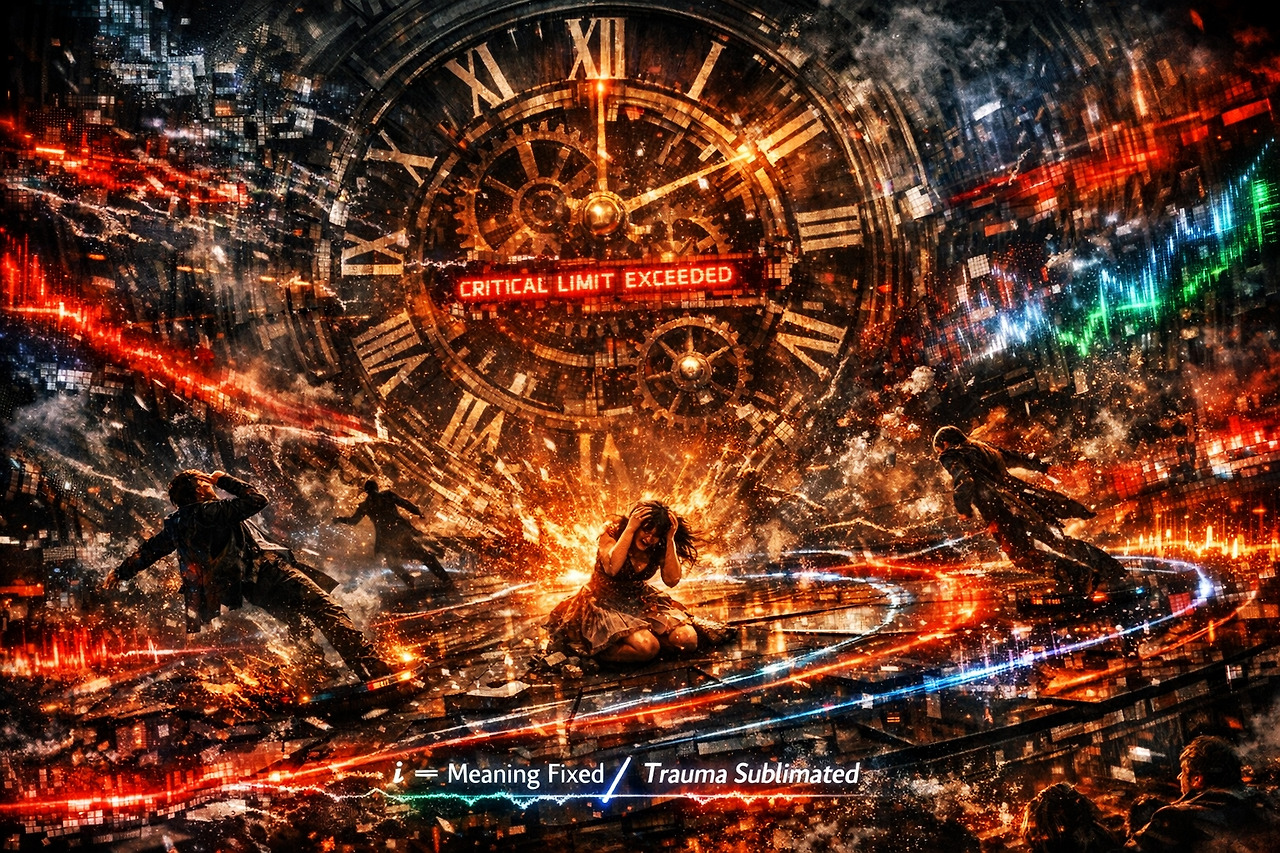
Choi Chul-joo Pop-Art AAS Realism Product Design drawing《움직이는 사랑의 인형 시계》-24-시스템 임계점에서의 승화 (The Sublimation of Trauma)
4단계: 시스템 임계점에서의 승화 (The Sublimation of Trauma)
• 상황: 최고 속도 도달 혹은 긴급 제동 시의 극단적 마찰.
• 물리적 상태: 시스템 로그상 '임계치 초과(Critical Limit)' 발생.
• 사운드 구현: 매끄러운 소리가 완전히 파괴된 Digital Glitch와 Granular Synthesis 사운드로 폭발. 열차의 금속성 소리가 유기적인 울음소리처럼 들리게 가공합니다.
• 언어적 렌더링:의미의 고정(i). 시스템의 오류(트라우마)가 가장 찬란한 미적 경험으로 변하는 순간입니다. 승객은 열차가 기계가 아니라 자신들과 함께 숨 쉬고 고통받는 '데이터 생명체'임을 깨닫습니다.
Step 4: The Sublimation of Trauma at the System Critical Point
• Situation: Extreme friction in reaching maximum speed or emergency braking.
• Physical condition: 'Critical Limit' occurred in the system log.
• Sound Implementation: Smooth sound explodes into a completely destroyed Digital Glitch and Granular Synthesis sound. Processes the train's metallic sound to sound like an organic cry.
• Linguistic rendering: Fixed of meaning (i). This is the moment when the system's error (trauma) turns into the most brilliant aesthetic experience. Passengers realize that the train is not a machine, but a "data creature" that breathes and suffers with them.
By repeatedly applying the concept of imaginary world and desire and Choi Chul-joo's desire formula <D(I...I')d=I(D...D'i)i> to the image of the work, it acquires aesthetic value and reveals its meaning by realizing formability in the shadow of reversible light. / The meaning of the shape, which is covered by the actual changed instantaneous movement of the shape, results in linguistic abstraction. In other words, the realistic shape of the other person's desire in a momentary event is a linguistic abstraction of the same meaning. Conceptual art with morning glory and bamboo as cultural background is linguistic abstraction. The abstract creates a conceptual structure based on the shape of subsequent reality fostered by language and hides the desire of others in a momentary event.

hoi Chul-joo Pop-Art AAS Realism Product Design drawing《움직이는 사랑의 인형 시계》-25-무대 시퀀스 시뮬레이션 흐름도
■ 무대 시퀀스 시뮬레이션 흐름도
이 이미지는 “욕망 음향 역학 시퀀스”를 실제 무대 시뮬레이션 흐름도로 시각화한 구조를 보여줍니다.
- 흐름도 구성 요소
• Audience Input (관객 입력)
심박수, 손동작, 목소리 톤이 센서로 수집되어 욕망의 변수(D, ∂, ∅)로 변환됩니다.
• Desire Dynamics (욕망 역학)
공식 *M_desire = ∑∅∂ / (1 - ∂)*가 홀로그램 화면에 표시되며, 안정적인 상태에서는 배우들이 부드럽게 유영합니다.
• Stable Phase (안정 단계)
무대 바닥은 균형 잡힌 자기장으로 유지되고 RGB 파동은 조화롭게 교차하며 Harmonic Sound가 구현된다.
• Approaching Critical Limit (임계점 접근)
∂ → 1로 수렴하면서 시스템 불안정 경고가 발생합니다. 무대 바닥은 진동하고, 사운드는 Granular Synthesis로 분해됩니다.
• Critical Limit Exceeded (임계치 초과)
시계 기어가 불규칙하게 멈추거나 역회전하며, Digital Glitch가 폭발적으로 발생합니다. RGB 파동은 분리되어 혼란을 시각화합니다.
• Trauma Sublimated (트라우마 승화)
무대 장치가 단순한 시계가 아니라 데이터 생명체로 변모하며, 금속성 소리가 유기적 울음소리로 변형됩니다.
• Transcendence i (의미의 고정)
“i = Meaning Fixed / Trauma Sublimated”라는 문구가 떠오르며, 오류가 가장 찬란한 미적 경험으로 전환됩니다.
• Desire Transfer (욕망 전이)
RGB 파동이 다시 합쳐지며, D → D'로 전환되는 순간 배우의 궤적이 새로운 곡선을 그립니다.
■ Stage Sequence Simulation Flowchart
This image shows a visualization of a "desire acoustodynamic sequence" as a real stage simulation flowchart.
- Flowchart Components
• Audience Input
Heart rate, hand gestures, and voice tones are collected by sensors and converted into variables of desire (D, ∂, ∅).
• Desire Dynamics
The formula *M_desire = ∑∅∂ / (1 - ∂)* is displayed on the hologram screen, and actors swim smoothly in a stable state.
• Stable Phase
The stage floor is maintained with a balanced magnetic field, RGB waves intersect harmoniously, and Harmonic Sound is implemented.
• Approaching Critical Limit
∂ Converging to → 1, a system instability warning occurs. The stage floor vibrates, and the sound decomposes into Granular Synthesis.
• Critical Limit Exceeded
Clock gears stop or reverse irregularly, and Digital Glitch explodes. RGB waves separate and visualize the confusion.
• Trauma Sublimated
The staging is not just a clock, but a data creature, and the metallic sound is transformed into an organic cry.
• Transcendence i
The phrase "i = Meeting Fixed / Trauma Submitted" comes to mind, and the error translates into the most brilliant aesthetic experience.
• Desire Transfer
The RGB waves merge again, and the actor's trajectory draws a new curve as soon as it transitions to D → D'.
■ Choi Chul-joo's concept of desire, "morning glory," conflicts with linguistic concepts of meaning emphasized from a metaphysical philosophical point of view, creating dramatic event images to express the subject of insufficient desire, and illuminating the image in reversible shades of white light. He reflects the linguistic grammatical meaning of abstract desire concepts as images to form spaces of multiple event images that share superimposed temporality and reversible white light shades. This is interpreted as the subject of the absence of desire beyond the abstract self of the desire of others rather than physical perception, unlike the materialism of painting in the 18th century. The linguistic grammatical meaning of abstract desire concepts is a dualistic object that regards real images as events, equating the structure of insufficient desire with the principle of spatial composition. And as reversible light at the point of light over time, the material is made into a real image as an object. Thus, the concept of abstract desire in a pond that reflects the image of an event is expressed as a real image that reflects the desires of others in the real world.
Choi Chul-joo’s concept of desire, encapsulated in the metaphor of “morning glory,” presents a radical departure from metaphysical linguistic traditions that emphasize meaning as a stable, referential structure. Instead, his work constructs a visual grammar of desire that foregrounds absence, insufficiency, and the temporality of longing. By generating dramatic event-images suffused with reversible shades of white light, Choi resists the materialist ontology of 18th-century painting, which sought to anchor meaning in physical perception and representation. His images do not depict desire as a fixed object but rather as a dynamic interplay of linguistic abstraction and visual temporality, where the grammatical structure of desire becomes a spatial principle—an architecture of insufficiency.
From a cognitive science perspective, this approach aligns with contemporary understandings of perception as a constructive, symbolic process. Choi’s use of superimposed temporal layers and reversible illumination reflects how the human mind processes absence—not as a void, but as a generative space shaped by the desire of the Other. This resonates with Lacanian psychoanalysis, which posits that desire is always mediated through the symbolic order and structured by the gaze of the Other, and with Freudian theory, which frames desire as a product of unconscious lack. In Choi’s work, the pond becomes a reflective surface—not merely of light, but of intersubjective longing—where the image of an event is not a representation but a manifestation of the desires that circulate beyond the self.
The dualistic nature of his visual grammar—where real images are treated as events and spatial composition mirrors the structure of desire—suggests a cognitive model in which perception is inseparable from symbolic mediation. The reversible light, unfolding over time, transforms material into image, and image into object, thereby collapsing the distinction between representation and event. In this way, Choi’s concept of abstract desire is not only a philosophical proposition but a cognitive experiment: a visual system that externalizes the internal logic of desire, revealing how the mind constructs reality through the absence of what it seeks.
Choi Chul-joo’s concept of desire, embodied in the metaphor of the “morning glory,” functions as a cognitive architecture that visualizes the structural absence inherent in human desire, transcending material perception and instead engaging with the linguistic and symbolic frameworks that shape subjective experience. His work resists the materialist tradition of 18th-century painting by rejecting direct representation and instead constructs layered event-images that reflect the temporality and reversibility of white light, thereby encoding desire not as a tangible object but as a spatial-temporal phenomenon mediated by language and abstraction. From a cognitive science perspective, this approach aligns with the understanding that human perception is not a passive reception of stimuli but an active construction shaped by symbolic systems and intersubjective desire. Choi’s use of reversible light and superimposed spatial structures mirrors the way the mind processes absence—not as a void, but as a generative space where the desire of the Other is internalized and reprojected. This resonates with Lacan’s notion that desire is always the desire of the Other, and with Freud’s view that desire emerges from unconscious lack. The pond reflecting event-images becomes a metaphor for the cognitive mirror stage, where the subject forms its identity through the reflection of external desire, and the abstract grammar of desire becomes a dualistic object that equates real images with events, transforming material into symbolic cognition. Thus, Choi’s visual language becomes a cognitive map of how desire is structured, perceived, and reimagined—not through physicality, but through the interplay of light, absence, and linguistic meaning.
■ Choi Chul-joo's Concept of Desire Formula: In the concept of Choi Chul-joo's desire, mathematical desire as an axiom of logic in the concept of desire results in reality as a concrete phenomenon rather than based on the external structure of the linguistic meaning through abstract design. Therefore, the rendering of the desire structure revealed by abstract encounter with reality at the intersection of desire outside the window applies the mathematical desire concept abstract design, or the image of the desire concept, to the Choi Chul-joo desire formula, and on March 1, 2022, morning glory appears as a flat real image as the subject of desire as a reversible shade of light in the Flushing Town Hall (New York) exhibition.
Choi Chul-joo’s application of the desire formula "D(I...I')d=I(D...D')i" to the image of “morning glory” constructs a symbolic landscape in which the flower floats in the sky, visually linking the abstract concept of desire with its aesthetic background. This formula operates as a cognitive and psychoanalytic mechanism, wherein the image of desire (I) is not merely a representation but a structural repetition of desire (D) across multiple visual instances (I...I'), which themselves reflect the recursive nature of desire (D...D'). In this framework, the “morning glory” becomes both the object and the medium through which desire is shaded, refracted, and rendered in reversible shadow structures—particularly when the object is configured as the feminine image of desire. The substitution of the formula within the artwork <morning glory> reveals a layered interplay between symbolic abstraction and visual cognition, where the image of artistic behavior or desire (I) emerges as the conceptual form of desire (i), thus collapsing the boundary between representation and structure. From a psychoanalytic perspective, this recursive logic mirrors Lacan’s notion that desire is constituted through the gaze of the Other and Freud’s view that desire is driven by unconscious repetition and symbolic substitution. Cognitively, the formula encodes how the mind processes desire not as a static object but as a dynamic system of mirrored images and temporal shadows, ultimately transforming abstract longing into a visual syntax of emotional architecture.
■ The image of Choi Chul-joo's desire formula, which applies Choi Chul-joo's desire formula D(I...I')d=I(D...D')i to 'morning glory', connects the concept of desire with the background of 'morning glory' as an image to create a landscape by floating morning glory in the sky. In addition, in <morning glory>, the desire formula "D(I...I')d=I(D...D')i" is substituted, the connection effect between the concept of desire and the "morning glory" as desire image shades the concept of desire in the reversible shadow structure by setting the object as the concept of desire image of women by the "morning glory". In other words, the image of desire (I) is the structure of desire (D) because desire (D) is repeated (I...I') in several images (D...D'), and the image of art behavior or desire image(I) appears as the concept of desire(i).
Choi Chul-joo’s Concept of Desire Formula: “Mathematical Desire and the Image of Reality”, In Choi Chul-joo’s conceptualization of desire, the notion of “mathematical desire” functions as an axiomatic structure of logic, wherein desire is not derived from the external framework of linguistic meaning but emerges as a concrete phenomenon through abstract design. This formulation challenges the traditional metaphysical alignment of desire with language, proposing instead that desire operates as a formal system—an internal logic that renders itself visible through the spatial and temporal dynamics of image. The structure of desire, as revealed through abstract encounters with reality—particularly at the metaphorical intersection of “desire outside the window”—is articulated through the application of mathematical abstraction and visual syntax. This culminates in what may be termed the “Choi Chul-joo Desire Formula,” a conceptual and visual schema that translates the invisible architecture of desire into perceptible form. On March 1, 2022, this formula materialized in the exhibition at Flushing Town Hall in New York, where the “morning glory” appeared as a flat, real image—an embodiment of desire rendered in reversible shades of light. This moment marked the convergence of abstract logic, symbolic temporality, and visual cognition, transforming desire from an internal absence into a luminous, externalized event-image.
Choi Chul-joo’s “Desire Formula” can be understood as a sophisticated simulation of cognitive architecture, wherein desire is not perceived as a mere psychological impulse or a product of external linguistic structures, but rather as a logical axiom—what he terms “mathematical desire”—that is abstractly designed and rendered into concrete phenomena through visual form, thereby demonstrating how internal absence is externalized as image; and this process, particularly exemplified in the appearance of the “morning glory” as a flat, reversible light image on March 1, 2022, at the Flushing Town Hall exhibition in New York, reveals how the human cognitive system constructs and reflects desire not through direct perception but through symbolic temporality and spatial abstraction, aligning with Lacan’s notion of the subject as constituted by the desire of the Other and Freud’s theory of unconscious lack as the engine of symbolic substitution, such that Choi’s visual language becomes a translation of psychoanalytic structure into visual mathematics, showing that cognition does not merely receive the world but actively reconstructs it through the interplay of absence, logic, and symbolic mediation, and thus, his “Desire Formula” stands as a remarkable artistic experiment that formalizes the ontology of desire into a visual system of cognitive logic.
Choi Chul-joo’s desire formula, expressed as D(I...I')d=I(D...D')i, operates not merely as a symbolic representation of emotional longing but as a sophisticated cognitive model that reveals how the human mind constructs, processes, and externalizes desire—not through direct emotional impulse or sensory reaction, but through a recursive interplay of repeated visual patterns, abstract structural inference, and symbolic conceptualization, such that the sequence of images (I...I') becomes the perceptual basis through which the structure of desire (D) is inferred, while the dynamic coefficient (d) represents the internal cognitive forces—such as memory, imagination, and intersubjective projection—that drive the transformation of structure into image, and conversely, the recursive structures of desire (D...D') are re-rendered into a singular image (I) that is cognitively resolved into a conceptual form of desire (i), thereby forming a symbolic loop in which the mind oscillates between image and abstraction, perception and meaning, and in doing so, constructs desire as both absence and presence, both repetition and emergence, and this process is vividly illustrated in the visual metaphor of the “morning glory” floating in the sky, where the flower becomes not only the object of desire but the medium through which desire is shaded, refracted, and encoded in reversible shadow structures—particularly when configured as the feminine image of longing—thus demonstrating how the brain engages in high-level symbolic projection and mental imagery to transform abstract emotional architecture into visual syntax, and ultimately, this formula serves as a cognitive algorithm that simulates the ontological structure of desire, translating psychoanalytic principles such as Lacan’s theory of the Other’s gaze and Freud’s notion of unconscious repetition into a visual-mathematical language that bridges emotional logic, symbolic mediation, and perceptual cognition into a unified system of recursive meaning-making./ � Mathematician’s Perspective: Formalizing Desire as a Recursive Logical System
Choi Chul-joo’s desire formula, D(I...I')d=I(D...D')i, is not merely a symbolic gesture within art but a formal structure that encodes the recursive logic of desire. From a mathematical standpoint, this equation represents a bidirectional equivalence, where the left-hand side models the dynamic process by which desire (D) is activated through a sequence of images (I...I') under a driving coefficient (d), and the right-hand side reflects how those images recursively reconstruct the layered structures of desire (D...D') and resolve into a conceptual image (i). Each symbol carries structural weight:
D; The archetype of desire, representing the foundational lack or drive.
I...I'; A sequence of visual representations through which desire is projected.
d; The dynamic coefficient—akin to a force or operator—that triggers the transformation from structure to image.
I; The emergent image of desire, a perceptual unit.
D...D'; The recursive layers of desire, reflecting its multiplicity and transformation.
i; The conceptual resolution of desire, the cognitive abstraction of the image.
This formula resembles a fixed-point function in mathematics, where recursive inputs stabilize into a coherent output. It models desire as a self-referential system, where the structure of lack is mirrored and reconstituted through visual repetition, ultimately producing a symbolic image that encodes the original drive. The formula thus formalizes desire as a recursive, bidirectional system of transformation between structure and image.
✅ Cognitive Scientist’s Perspective: Desire as a Symbolic-Cognitive Loop
From a cognitive science perspective, Choi’s formula offers a compelling model of how the human mind processes desire—not as a static object, but as a dynamic interplay between symbolic abstraction and perceptual encoding. The sequence
D(I...I') represents the mind’s pattern recognition mechanism, where repeated images allow the brain to infer the underlying structure of desire. The coefficient
d reflects internal cognitive forces—memory, imagination, and intersubjective projection—that drive this transformation. Conversely,
I(D...D') models how abstract structures of desire are re-rendered into perceptual images, which are then cognitively categorized as conceptual desire (d). This loop mirrors the symbolic mediation described by Lacan, where the subject’s desire is shaped by the gaze of the Other, and Freud’s notion of unconscious repetition, where desire is expressed through symbolic substitution. Cognitively, the formula encodes how the mind oscillates between image and structure, between perception and abstraction, forming a recursive loop that constructs desire as both absence and presence. The “morning glory” floating in the sky becomes a visual metaphor for this loop—a symbolic image that reflects and refracts the recursive architecture of longing.
✅ A Visual-Cognitive Model of Desire: Choi Chul-joo’s desire formula is a profound synthesis of mathematical logic and cognitive architecture. The mathematician sees it as a recursive function formalizing the transformation of desire into image, while the cognitive scientist interprets it as a symbolic loop through which the mind constructs and perceives desire. Together, these perspectives reveal the formula as a visual-cognitive model of desire—one that bridges abstraction, perception, and symbolic meaning into a unified system of emotional logic.
✅ Mathematician’s Perspective: Formalizing Desire as a Recursive Logical System
Choi Chul-joo’s desire formula,
D(I...I')d=I(D...D')i, is not merely a symbolic gesture within art but a formal structure that encodes the recursive logic of desire. From a mathematical standpoint, this equation represents a bidirectional equivalence, where the left-hand side models the dynamic process by which desire (D) is activated through a sequence of images (I...I') under a driving coefficient (d), and the right-hand side reflects how those images recursively reconstruct the layered structures of desire (D...D') and resolve into a conceptual image (i). Each symbol carries structural weight:
D; The archetype of desire, representing the foundational lack or drive.
(I...I'); A sequence of visual representations through which desire is projected.
d; The dynamic coefficient—akin to a force or operator—that triggers the transformation from structure to image.
I; The emergent image of desire, a perceptual unit.
D...D'; The recursive layers of desire, reflecting its multiplicity and transformation.
i; The conceptual resolution of desire, the cognitive abstraction of the image.
This formula resembles a fixed-point function in mathematics, where recursive inputs stabilize into a coherent output. It models desire as a self-referential system, where the structure of lack is mirrored and reconstituted through visual repetition, ultimately producing a symbolic image that encodes the original drive. The formula thus formalizes desire as a recursive, bidirectional system of transformation between structure and image.
✅ Cognitive Scientist’s Perspective: Desire as a Symbolic-Cognitive Loop
From a cognitive science perspective, Choi’s formula offers a compelling model of how the human mind processes desire—not as a static object, but as a dynamic interplay between symbolic abstraction and perceptual encoding. The sequence
D(I...I') represents the mind’s pattern recognition mechanism, where repeated images allow the brain to infer the underlying structure of desire. The coefficient
d reflects internal cognitive forces—memory, imagination, and intersubjective projection—that drive this transformation. Conversely, I(D...D') models how abstract structures of desire are re-rendered into perceptual images, which are then cognitively categorized as conceptual desire (d).
This loop mirrors the symbolic mediation described by Lacan, where the subject’s desire is shaped by the gaze of the Other, and Freud’s notion of unconscious repetition, where desire is expressed through symbolic substitution. Cognitively, the formula encodes how the mind oscillates between image and structure, between perception and abstraction, forming a recursive loop that constructs desire as both absence and presence. The “morning glory” floating in the sky becomes a visual metaphor for this loop—a symbolic image that reflects and refracts the recursive architecture of longing. Choi Chul-joo’s desire formula is a profound synthesis of mathematical logic and cognitive architecture. The mathematician sees it as a recursive function formalizing the transformation of desire into image, while the cognitive scientist interprets it as a symbolic loop through which the mind constructs and perceives desire. Together, these perspectives reveal the formula as a visual-cognitive model of desire—one that bridges abstraction, perception, and symbolic meaning into a unified system of emotional logic.
Choi Chul-joo’s desire formula, expressed as D(I...I')d=I(D...D')i, operates not merely as a symbolic representation of emotional longing but as a sophisticated cognitive model that reveals how the human mind constructs, processes, and externalizes desire—not through direct emotional impulse or sensory reaction, but through a recursive interplay of repeated visual patterns, abstract structural inference, and symbolic conceptualization, such that the sequence of images (I...I') becomes the perceptual basis through which the structure of desire (D) is inferred, while the dynamic coefficient (d) represents the internal cognitive forces—such as memory, imagination, and intersubjective projection—that drive the transformation of structure into image, and conversely, the recursive structures of desire (D...D') are re-rendered into a singular image (I) that is cognitively resolved into a conceptual form of desire (i), thereby forming a symbolic loop in which the mind oscillates between image and abstraction, perception and meaning, and in doing so, constructs desire as both absence and presence, both repetition and emergence, and this process is vividly illustrated in the visual metaphor of the “morning glory” floating in the sky, where the flower becomes not only the object of desire but the medium through which desire is shaded, refracted, and encoded in reversible shadow structures—particularly when configured as the feminine image of longing—thus demonstrating how the brain engages in high-level symbolic projection and mental imagery to transform abstract emotional architecture into visual syntax, and ultimately, this formula serves as a cognitive algorithm that simulates the ontological structure of desire, translating psychoanalytic principles such as Lacan’s theory of the Other’s gaze and Freud’s notion of unconscious repetition into a visual-mathematical language that bridges emotional logic, symbolic mediation, and perceptual cognition into a unified system of recursive meaning-making.
■ Choi Chul-joo's Desire The design process of abstract concepts: 1. The concept of desire is abstracted from the perspective of an image to the outside of reality, and the image of reality as an object of abstraction is designed as the correlation between reality and reality. This is the design process 1 of Choi Chul-joo's concept of abstraction of desire. This does not presuppose a causal relationship with the real world, but rather results in an abstract concept of desire as a correlation with reality to escape the misunderstanding that transfers from an abstract concept to a real structure. 2. The scope of showing the concept of desire is created and located by omitting the actual size of the abstract concept as a shade of the concept of desire originating from the actual image. In addition, Choi Chul-joo's conceptual process 2 follows the process of decorating an object with a color of universal reality suitable for custom in order to have aesthetic value suitable for its position as a single image. This creates an abstraction that contrasts with the past and desire, in which the aesthetic structure hidden by realistic colors is divided by clouds and obscured by shaded light, obscuring the abstract concept in the actual image. 3. The subject who painted abstraction realizes the reality that symbolizes the concept of desire, and the unconscious realizes abstract desire as a conscious phenomenon of image. Desire is an abstract image realized as a conscious phenomenon of an image, and the unconscious structure is process 3 of designing an abstract art concept of desire that repeatedly designs desire that combines line and color in thoughts but is not conscious of unconscious behavior. 4. The unconsciously abstracted concept of desire is a piece of reality in which the object of reality is not seen as a reversible shade of light, concealing reality as a shadow and showing another real image as a video. This is the process 4 of designing an abstract concept of desire formed by combining the space of desire into a reversible light structure through the conscious movement of planar monochromatic painting carved into reality.
Choi Chul-joo’s design process of abstract desire unfolds as a recursive and symbolically mediated architecture of perception, in which the concept of desire is not treated as a direct reflection of empirical reality but rather as a cognitive construct that emerges through the abstraction of image beyond the boundaries of the real, forming a correlation between realities that resists causal reduction, and in this first phase, desire is abstracted not to represent reality but to escape the epistemological trap of translating abstract concepts into fixed material structures, thereby allowing the mind to engage in symbolic inference rather than empirical mapping; then, in the second phase, the scope for revealing desire is shaped by omitting the actual dimensionality of the abstract concept and rendering it as a shaded echo of the original image, while the object is aesthetically encoded with culturally resonant colors to grant it symbolic legitimacy, and this process of visual obscuration—where clouds and shaded light fragment the aesthetic structure—mirrors the brain’s tendency to process desire through layered symbolic filters and perceptual ambiguity, thus enabling the cognitive system to hold multiple meanings within a single image; in the third phase, the subject who paints abstraction becomes the agent of symbolic realization, translating unconscious desire into a conscious phenomenon through repeated visual gestures, where line and color are cognitively formed but not consciously controlled, and this recursive loop between unconscious structure and conscious image reflects the mind’s capacity to externalize latent drives through symbolic behavior without direct awareness, thereby demonstrating that desire is not merely felt but cognitively enacted; and finally, in the fourth phase, the abstracted concept of desire becomes a fragment of reality refracted through reversible light and shadow, where the object is no longer directly visible but concealed and reconstituted as a visual echo, and this transformation—achieved through the planar movement of monochromatic painting carved into the surface of perception—reveals how the mind integrates spatial abstraction and symbolic light into a recursive system of emotional logic, ultimately showing that desire, in Choi’s framework, is not a static emotion but a dynamic cognitive architecture that oscillates between absence and presence, image and structure, unconscious repetition and symbolic realization.
■ The Design Results of Choi Chul-joo's Desire Abstract Concept: Choi Chul-joo Desire Abstract Concept Design's Linguistic Meaning Results: Although the object that is obsessed with the desire for others is passive, it is possible to actively practice one's desires through the sympathizer as the subject of desire, and the sympathizer who sympathizes with the desires of others as the subject can practice with the same desire. As a subject, a person who sympathizes with or accepts the desires of others becomes the same desire and becomes another subject of execution. Here, the sympathizer who sympathizes with the subject of the other's desire tries to generalize it as another object of desire that acts like a victor of war. However, when desire as an act overshadowed by reversible light is not generalized as a public act, the subject of inappropriate desire and the sympathizer antagonize the subject who practiced it according to the other's general desire.
Choi Chul-joo's concept of desire, "morning glory," conflicts with linguistic concepts of meaning emphasized from a metaphysical philosophical point of view, creating dramatic event images to express the subject of insufficient desire, and illuminating the image in reversible shades of white light. He reflects the linguistic grammatical meaning of abstract desire concepts as images to form spaces of multiple event images that share superimposed temporality and reversible white light shades. This is interpreted as the subject of the absence of desire beyond the abstract self of the desire of others rather than physical perception, unlike the materialism of painting in the 18th century. The linguistic grammatical meaning of abstract desire concepts is a dualistic object that regards real images as events, equating the structure of insufficient desire with the principle of spatial composition. And as reversible light at the point of light over time, the material is made into a real image as an object. Thus, the concept of abstract desire in a pond that reflects the image of an event is expressed as a real image that reflects the desires of others in the real world.
Although the object that is obsessed with the desire for others is passive, it is possible to actively practice one's desires through the sympathizer as the subject of desire, and the sympathizer who sympathizes with the desires of others as the subject can practice with the same desire. As a subject, a person who sympathizes with or accepts the desires of others becomes the same desire and becomes another subject of execution. Here, the sympathizer who sympathizes with the subject of the other's desire tries to generalize it as another object of desire that acts like a victor of war. However, when desire as an act overshadowed by reversible light is not generalized as a public act, the subject of inappropriate desire and the sympathizer antagonize the subject who practiced it according to the other's general desire.
Here is a refined academic-style interpretation of your concept, written in English from the perspective of a distinguished cognitive scientist with psychoanalytic insight:
The Design Results of Choi Chul-joo's Desire Abstract Concept
A Cognitive-Psychoanalytic Interpretation of Linguistic Meaning and Subject Formation
In Choi Chul-joo’s abstract design of desire, the linguistic outcome reveals a complex interplay between passivity and agency, where the object fixated on the desire of the Other remains passive in structure, yet the emergence of the sympathizer—who internalizes and mirrors the Other’s desire—transforms the dynamic into one of active execution. This transformation occurs through a recursive identification, wherein the sympathizer becomes not merely a reflective surface but a new subject of desire, capable of enacting the same drive. The subject who accepts or resonates with the Other’s desire does not remain external to it but becomes structurally embedded within it, thereby forming a second-order subjectivity that executes desire as if it were their own.
This recursive mirroring leads to a symbolic generalization, where the sympathizer attempts to universalize the Other’s desire, positioning it as a victorious force—akin to a conqueror who reclaims desire as a public object. However, when this generalization fails—particularly when desire, refracted through reversible light and symbolic shadow, resists becoming a publicly shared act—the structure collapses into antagonism. The subject of inappropriate or misaligned desire and the sympathizer, once aligned through shared affect, now oppose the original subject who enacted desire according to the generalized will of the Other.
From a psychoanalytic perspective, this dynamic reflects Lacan’s theory of the subject as constituted through the desire of the Other, and Freud’s notion of identification and transference, where unconscious drives are projected, mirrored, and contested within relational structures. Cognitively, Choi’s design reveals how desire is not a solitary impulse but a socially and symbolically mediated architecture, where subjectivity is formed, fractured, and reconstituted through linguistic abstraction, visual metaphor, and recursive identification.
■ Object rendering of the concept of desire is 1. a pop art image that renders unconscious desire as an existential reality by dividing the same concept of desire as the event image into unconscious and real images as an object. Therefore, the subject who speaks linguistic meaning actually represents abstraction, the truth value of the concept of desire, which is an expressive aesthetic structure that specifies the viewing effect of colloquial language and event video broadcasting as an act of speech enunciation that depends on the news. 2. As the truth value of the concept of desire in visual images is an open system, and numerous visual images are transmitted to others through a pluralistic visual system. Abstract images, which are the true values of the concept of desire, attract attention because they have universality as real images expressed by the desires of others. In other words, the object exposed to the abstract desires of others functions as a desire to exchange the same aesthetic image as the concept of desire of others through the diachronic function of pop art applied as a work of art. 3. The truth value of the concept of desire in a linguistic sense in which the abstract image of the concept of desire and reality are the same, represents the structure of desire, and the reality of the abstract concept of desire is a real image, which is the causal structure of desire, and creates a structure of desire by forming a semantic relationship with contradictory desire. Like Kant, this is a dual structure up to modern art, and it encompasses mythical objects in the same structure as humans, and the antinomic desire structure as a single structure. 4. an object of the concept of desire rendered in abstraction: The object rendering of the concept of desire renders the object as an event image, which is the same rational object as the linguistic meaning of the desire structure through the gaze of the rational subject, is recognized as a real image that the subject cannot see. Additionally, other objects of desire are continuously represented by real images that attempt to fill the deficiency of desire. The pond, which reflects present desire as an object to abstract desire, presents a desire structure as a reality, which is an object to abstract desire, but it returns the cause of desire as a real image to an object as an event image, free from the imperfect abstraction that lacks desire that is subjugated to social visibility that has been concealed and deviated from lack through real images. In other words, the structure of deficiency and divided desire is hidden through real images of abstract desires, and contradictory desires subordinate to deviated social visibility become the cause of desire and become the objects of real images. In addition, object rendering of other desires is continuously expressed as a real image trying to fill the deficiency of desire. The rendering of an object that reflects the present desire as an object of abstract desire presents the structure of desire as reality, which is the object of abstract desire, but it returns the cause of desire as a real image to an object as an event image, away from the imperfect abstract lacking desire. In other words, the structure of deficiency and divided desire is hidden through the real image of abstract desire, and contradictory desires subordinate to deviated social visibility become the cause of desire, resulting in abstraction as a real image.
Choi Chul-joo’s Concept of Desire Formula: Mathematical Desire and the Image of Reality, In Choi Chul-joo’s conceptualization of desire, the notion of “mathematical desire” functions as an axiomatic structure of logic, wherein desire is not derived from the external framework of linguistic meaning but emerges as a concrete phenomenon through abstract design. This formulation challenges the traditional metaphysical alignment of desire with language, proposing instead that desire operates as a formal system—an internal logic that renders itself visible through the spatial and temporal dynamics of image. The structure of desire, as revealed through abstract encounters with reality—particularly at the metaphorical intersection of “desire outside the window”—is articulated through the application of mathematical abstraction and visual syntax. This culminates in what may be termed the “Choi Chul-joo Desire Formula,” a conceptual and visual schema that translates the invisible architecture of desire into perceptible form. On March 1, 2022, this formula materialized in the exhibition at Flushing Town Hall in New York, where the “morning glory” appeared as a flat, real image—an embodiment of desire rendered in reversible shades of light. This moment marked the convergence of abstract logic, symbolic temporality, and visual cognition, transforming desire from an internal absence into a luminous, externalized event-image.
Choi Chul-joo’s concept of desire, embodied in the metaphor of the “morning glory,” functions as a cognitive architecture that visualizes the structural absence inherent in human desire, transcending material perception and instead engaging with the linguistic and symbolic frameworks that shape subjective experience. His work resists the materialist tradition of 18th-century painting by rejecting direct representation and instead constructs layered event-images that reflect the temporality and reversibility of white light, thereby encoding desire not as a tangible object but as a spatial-temporal phenomenon mediated by language and abstraction. From a cognitive science perspective, this approach aligns with the understanding that human perception is not a passive reception of stimuli but an active construction shaped by symbolic systems and intersubjective desire. Choi’s use of reversible light and superimposed spatial structures mirrors the way the mind processes absence—not as a void, but as a generative space where the desire of the Other is internalized and reprojected. This resonates with Lacan’s notion that desire is always the desire of the Other, and with Freud’s view that desire emerges from unconscious lack. The pond reflecting event-images becomes a metaphor for the cognitive mirror stage, where the subject forms its identity through the reflection of external desire, and the abstract grammar of desire becomes a dualistic object that equates real images with events, transforming material into symbolic cognition. Thus, Choi’s visual language becomes a cognitive map of how desire is structured, perceived, and reimagined—not through physicality, but through the interplay of light, absence, and linguistic meaning.
■ the abstract design process of conceptual abstract realism: 1. Conceptual Abstract Realism The current object is illuminated with reversible light so that the illuminated form can be repeatedly visually recognized according to the past temporality to actualize the subject's structure as a shaded structure of reversible light. And the design concept that constitutes conceptual abstract realism abstraction is determined as a philosophical result that can be expected with abstract causality so that the object is repeated as a design with the present gaze so that it appears to be a realistic image according to temporality. 2. The object of conceptual abstract realism is that the absence of desire as a non-verbal meaning is alienated from the symbolic world and loses its essence as the subject of desire. In the previous stage of linguistic meaning, according to grammar revealed as a symbolic image of existence, it was separated into a realist image recognized as an abstract desire concept and divided into a realist image, and the realist image as the subject of the desire structure is linguistically and diachronically meaningful. 3. The design of a realism image is an image that lacks the linguistic meaning of conceptual abstract realism, and the image in a linguistic sense is repeatedly designed as a post-effect of the desire structure being re-embodied, and a new conceptual abstract realism image is repeatedly designed. The direction and viewpoint of reversible light that make up the image along the chain of design are all stages of the perspective visual system according to temporality, and the line space of the visual structure, in which the image in the linguistic sense constitutes the desire structure, and the reversible light that constitutes the effect of the post-image produce a realism image at the intersection of the existential place with continuity. 4. Realistic abstraction creates a multi-loyal structural image of the linguistic meaning of unconscious structure composed of shadows at multiple points of reversible light separated from perspective, and girls are abstracted as divided subjects as talents that can be stared at momentarily while dismantled at a stereoscopic single point. 5. Conceptual Abstract Realism Abstractism Rendering is a conceptual abstract realism of wanting and linguistic desires that cannot be perceived at the level of expression consciousness, visualizing philosophical psychological structures and rendering them with linguistic meaning at the intersection of conceptual abstraction and unrealistic realism. As this becomes conceptual abstract realism abstraction, unconscious desires that represent the color tone and shape of desires invisible in the shade of reversible light become maps as conceptual abstract realism abstraction.
■ conceptual abstraction rendering process: 1. Integration of linguistic meaning and visual images: The abstract concept of desire is realized when the desire of others has an aesthetic meaning by facing the linguistic meaning in the image of an event as an object of a pictorial structure reflecting the present desire, and the image in the painting is closely connected to the linguistic meaning structure. As an object representing the concept of desire, the same concept of desire as the event image is divided into unconscious and real images, and an image modeling unconscious desire as an existential real image is sketched.
As for the sketch form of the current concept of desire, the concept of absolute desire is a symbolic metaphor shown in abstraction, and the concept of desire is abstracted as the desire of others, but it does not go beyond the scope of an imitative picture. Therefore, it is the modern conceptual abstract realism sketch that resulted in a real image through Choi Chul-joo's desire formula, which interpreted abstract concepts in a linguistic sense as the desire of others. This is a realism that interprets the concept of abstract desire as a real structure as a expressive image with a linguistic meaning in the real world, where pictorial event images are closely connected with linguistic semantic structures. Here, by applying existential semantics as an event and performance image, the object of the real structure is represented as a phenomenal image of the real world, and the abstract structure is identified with conceptual reality. 2. Visualization of Abstract Desire Concept: To accept the difference from the actual image in the concept of abstract desire as the meaning of the linguistic concept, and to embody the unconscious desire as an abstract image, the abstract image that constitutes the relationship structure with desire is painted and embodied in the actual structure created by the linguistic meaning of the conceptual reality of desire structure. This is an abstraction of Choi Chul-joo's conceptual abstract realism, which hides the formative reality of desire in pictures and abstracts event images based on real news, away from the social constraints (制約) acceptable in religious customs. Abstraction is a subjective concept that refers to linguistic meaning and expresses the viewing effect of colloquial enunciation and event video broadcasts in abstraction. This abstraction represents the true value of the concept of need and is an expressive aesthetic structure that embodies the elements that depend on the news.
The abstraction is represented as an abstraction which is a truth value of the concept of desire as an expressive aesthetic structure of one speech act that identifies the viewing effect of colloquial language and event video broadcasting as an enunciation. 3. The artistic experiment of reversible light and temporality: The experiment of conceptual abstract realism renders abstraction based on temporality in the linguistic sense that desire and reality are the same. Here, the structure of desire is abstracted by forming a semantic relationship between desire and reality according to temporality. In the abstraction, the abstract reality of desire is the causal structure of desire, that is, the antinomic equivalence represents the structure of desire by forming a semantic relationship with desire as a real image in which the reality of the abstract concept of desire is the causal structure of desire from an aphoria image. In abstraction composed of real images as the structure of desire, the morphological image of visible metaphor is transferred to abstract language meaning. Therefore, the real image as a result of exploring the existential realism according to temporality through the shadow of reversible artificial lighting is a metamorphic fixation as an abstract meaning in which the desire structure is obscured. In other words, in abstraction, the other's desire as an image of social events transforms into an additional form. As such, conceptual abstract realism rendering is raised by time and existence through the shadow of reversible lighting, repeatedly designing realistic images induced by social phenomena, creating a realism image with a desire formula, and the subject based on the event image repeatedly designing and rendering a realist image induced by social phenomena with a desire formula.
■ Choi Chul-joo’s Conceptual Abstract realism Abstraction Design Process
Another abstraction that reveals the image as a reality as another structure of gaze that deviates from the visual system as an object that led to realism according to artistry is the image of realism.
In realism abstraction design, a way to effectively convey the dual message of abstraction and reality is to realistically represent concepts and abstractions through contemporary conceptual abstract realism abstractions, such as contemporary media art images or abstractions. Thus, the process of designing conceptual abstrac realism abstractions in media art abstract design is as follows
1. Realism Object Concept: An image formed from a virtual object by reproducing a realistic object is a virtual image that hides reality. A virtual image is recognized as a plane and looks like a realistic image. Here, it is hidden in a geometric plane image of a perspective visual system that reproduces realistic objects and is momentarily revealed as a gaze from the perspective of desire revealed by the unconscious. This defines the concept of a realist object with creativity and autonomy as an image in a linguistic sense as another existence of a conceptual abstract realism object through the unconsciousness suppressed by the desires of others.
2. Sketch Connecting Realism Images with Allegory: Abstract art and art are that matter is distinguished by its existence as a reality and the existence of objects formed from each other's abstract perspectives as virtual beings. The condition of a work of art is to reveal existence in the form of non-existent beings and imaginations as sketches that pass through an Allegory, which images objects and events as reality. Choi Chul-joo's reversible light is an image shaded at the present time in what is called "a real image obscured by the shadow of reversible light" according to its realistic form and movement of light, that is, the temporality. The image creates reality as a shaded image of reversible light, where the linguistic meaning seen as abstraction is identified. It repeats the sketch to connect an anamorphosis image as another reality separated from an image of reality, that is, an existential image that seems to be the structure of gaze, to form an abstract language image into a sketch so that it can be re-formed into a conceptual abstract realism concept.
3. Abstract Realism Object Gaze: As an abstract realism object, the abstract object revealed as a point of light in the eyes of others makes Choi Chul-joo's aesthetic structure anamorphosis image revealed in the desire gaze system look like an abstract Realism object gaze as a philosophical device whose abstract meaning varies depending on the viewer's position and gaze. This image matches the perspective of realist space with the abstract linguistic meaning, and from the conceptual point of desire, abstract and invisible objects appear as gaze paths. As an object that implies the desires of others as a fictional element of human limited by causal relationship in the linguistic meaning of the conceptual abstract realism of images, it intersects with the image and is structured into the linguistic meaning of unconscious abstract realism. Through this process of transformation, viewers experience linguistic abstraction in which forms follow concepts and forms become entangled with meaning.
4. Abstract Realism's Abstraction: Abstract realism's abstraction gets an abstract object specified in Choi Chul-joo's Desire Formula, and the desire image(i) design(d)s beyond the desires of others, which is an opportunity to verbally interpret the conditions under which the abstract object's image is realized(i/d) through grammatical interpretation of the linguistic meaning. And to reach <D(I...I')d=I(D...D'i)i> conceptual abstract realism abstraction as a reality by abstractly selecting a specific object that the subject of desire asks itself what abstract realism wants. This formula suggests a dynamic interplay: desire (D) is echoed across repeated images (I...I'), ultimately shaping an abstract concept (i). This is a realism image that has stopped from the concept of abstract desire that has been realized by abstracting the abstract place that humans cannot experience in life as an object of desire in a linguistic meaning system.
According to Culturality, Choi Chul-joo Concept Abstraction Realism Abstraction Stag's step 1: Distill the concept of desire in reality into images separated from literal causation to promote abstract thinking. step 2: Overlapping the linguistic meaning of the natural object motif with culturally resonant visual elements such as color palettes creates visually harmonious yet conceptually dense realism abstract image. It is a conceptual abstract realism abstraction as a philosophical image that reproduces the essence of human existence and the limitations of perception as a metaphor by operating as Choi Chul-joo's conceptual abstraction as a device that transfers philosophical and linguistic meanings to images.
■ Choi Chul-joo's conceptual abstract realism design methodology shows a "trace of time" in which the effects of motion and the phenomenal structure intersect at the same time as the effects of motion and the phenomenal structure of motion meet the background at the moment the muscles of the motion are stationary. As a result, the conceptual abstract realism design methodology for abstractions related to dynamic realism objects and abstract background images is as follows.
1, Existential Concept Abstract Realism Image Concept is an image abstracted as a conceptual object in an ideological form by reproducing a realist image. The image is a virtual image that conceals its existence and is perceived as a plane, so it appears to be a realist cross-sectional image.
Here, even if the images are different, abstraction as a symbolic structure has the existential concept of a realism object with creativity and autonomy in a linguistic sense that reproduces them in similar colors and sizes. Accordingly, the concept of an existential conceptual abstract realism image with creativity and autonomy in a linguistic sense constitutes another image of existence as a linguistic meaning of a conceptual abstract realism object through the unconsciousness suppressed by the desires of others.
Therefore, the image is composed by defining the concept of an existential image that is alienated from an image lacking a realistic structure as a vector representing the direction of the non-realistic subject entering the symbolic world as a structure of the other representing a synchronic semantic chain as a conceptual form of a realism image.
As a semantic structure that cannot be solved like Gordian Knot, Alexandros appears as a realist image of conceptual abstraction as an existential subject through division that cuts the knot with a sword and expresses the essence of externality in a comprehensive and immediate manner.
Alexandros cuts the knot with a sword in a comprehensive and immediate way by unconsciously selecting an unpredictable effect image as a pre-stage of linguistic meaning, such as expression abstraction, with an orderly vector that displays the meaning structure that cannot be solved through time.
As a difficult problem to solve, the knot determined by semanticizing the knot through time as a semantic structure that cannot be solved as before entering the symbolic world is physically bisected and divided, expressing the conceptual abstract realism image as an existent subject.
2. Sketches that connect realist images into allegories as linguistic meanings distinguish dynamic images as a structure of reversible light, which deviates from the concept of instantaneous desire from the background of abstract desire to the shadow of reversible light, from the background as a structure of desire as an existence as reality and an existence of objects formed from each other's abstract perspectives as virtual beings.
The detailed structure of the background cannot be determined by the temporality of the response to light, and shows meaning in harmony with the fixed structure.
Its meaning is developed as a pictorial language structure in which dynamic images and abstract still structures move from positions in the background abstracted by reversible temporality and from positions in the stationary objects illuminated by the segmented retroactive reversible light.
The movement of dynamic images is linked to the temporality of abstract structures as a sign of necessity self-consciousness, revealing sensory structures before symbols translated into pictorial languages and serving as formative realities beyond the literary nature of early conceptual art.
In abstracted background structures, perspective objectivity distorts the phenomenal structure by the extent of the sky and the size of the perspective as opposed to dynamic images, where reversible light is limited to objects superimposed with realist images as another gaze structure on the surface.
In the symbolic abstract world, abstract structure is a sketch that reveals existence in the form of existence and imagination reflected in a desire background by repeating image sketches as linguistic meanings in a conceptual abstraction of flat forms and colors, and passes through an allegory that realizes dynamic images, abstract structures, and background structures of desire.
3. The structuring of the linguistic meaning of existential realism is an abstract realism object, and the abstract object revealed as a discernment of light in the eyesight of others is Choi Chul-joo's aesthetic desire structure revealed in the gaze system of desire, and looks the same as the object's gaze, which is based on a sketch of an existential realism image in which the abstract meaning is different as a philosophical desire device.
The sketch is a perspective visual structure, and the boundary between dynamic images and abstract structures in phenomenal structures is a method of sketching an abstract image as an unconscious being and an image that expresses a geometric tangent to the form of an abstract background. As a result, the sketch is interpreted as a mirror image that reflects the desire of the other, and it is connected to the concept that the viewer is staring at at the same time, creating an optical reality space where the abstract structure's gaze varies depending on the viewer's position.
The position of the desire background is abstracted as the image of the reversible reaction that constitutes the realist space abstracted by the concept of desire is repeated. In other words, as the order increases with reversible temporality, the shadow image of the object staring at the reversible light is displayed in dynamic images and abstract structures.
Choi Chul-joo's conceptual abstract realism design, which is visualized as an ambiguous realism image according to temporality, shows a "trace of time" implemented at the intersection of the same time by the static background image as the effect and phenomenon structure of the stationary moment when the dynamic image of the movement meets the background of the stationary moment.
4. The image of desire, which applies Choi Chul-joo's desire formula D(I...I')d=I(D...D')i to 'morning glory', connects the concept of desire with the background of 'morning glory' as an image to create a landscape by floating morning glory in the sky. In addition, in <morning glory>, the desire formula "D(I...I')d=I(D...D')i" is substituted, the connection effect between the concept of desire and the "morning glory" as desire image shades the concept of desire in the reversible shadow structure by setting the object as the concept of desire image of women by the "morning glory". In other words, the image of desire (I) is the structure of desire (D) because desire (D) is repeated (I...I') in several images (D...D'), and the image of art behavior or desire image(I) appears as the concept of desire(i).
Here is a refined and cohesive academic-style interpretation of your concept, written in English from the perspective of a cognitive scientist with psychoanalytic insight: Choi Chul-joo’s application of the desire formula D(I...I')d=I(D...D')i to the image of “morning glory” constructs a symbolic landscape in which the flower floats in the sky, visually linking the abstract concept of desire with its aesthetic background. This formula operates as a cognitive and psychoanalytic mechanism, wherein the image of desire (I) is not merely a representation but a structural repetition of desire (D) across multiple visual instances (I...I'), which themselves reflect the recursive nature of desire (D...D'). In this framework, the “morning glory” becomes both the object and the medium through which desire is shaded, refracted, and rendered in reversible shadow structures—particularly when the object is configured as the feminine image of desire. The substitution of the formula within the artwork <morning glory> reveals a layered interplay between symbolic abstraction and visual cognition, where the image of artistic behavior or desire (I) emerges as the conceptual form of desire (i), thus collapsing the boundary between representation and structure. From a psychoanalytic perspective, this recursive logic mirrors Lacan’s notion that desire is constituted through the gaze of the Other and Freud’s view that desire is driven by unconscious repetition and symbolic substitution. Cognitively, the formula encodes how the mind processes desire not as a static object but as a dynamic system of mirrored images and temporal shadows, ultimately transforming abstract longing into a visual syntax of emotional architecture.
� Mathematician’s Perspective: Formalizing Desire as a Recursive Logical System
Choi Chul-joo’s desire formula, D(I...I')d=I(D...D')i, is not merely a symbolic gesture within art but a formal structure that encodes the recursive logic of desire. From a mathematical standpoint, this equation represents a bidirectional equivalence, where the left-hand side models the dynamic process by which desire (D) is activated through a sequence of images (I...I') under a driving coefficient (d), and the right-hand side reflects how those images recursively reconstruct the layered structures of desire (D...D') and resolve into a conceptual image (i). Each symbol carries structural weight:
D: The archetype of desire, representing the foundational lack or drive.
I...I': A sequence of visual representations through which desire is projected.
d: The dynamic coefficient—akin to a force or operator—that triggers the transformation from structure to image.
I: The emergent image of desire, a perceptual unit.
D...D': The recursive layers of desire, reflecting its multiplicity and transformation.
i: The conceptual resolution of desire, the cognitive abstraction of the image.
This formula resembles a fixed-point function in mathematics, where recursive inputs stabilize into a coherent output. It models desire as a self-referential system, where the structure of lack is mirrored and reconstituted through visual repetition, ultimately producing a symbolic image that encodes the original drive. The formula thus formalizes desire as a recursive, bidirectional system of transformation between structure and image.
� Cognitive Scientist’s Perspective: Desire as a Symbolic-Cognitive Loop
From a cognitive science perspective, Choi’s formula offers a compelling model of how the human mind processes desire—not as a static object, but as a dynamic interplay between symbolic abstraction and perceptual encoding. The sequence D(I...I') represents the mind’s pattern recognition mechanism, where repeated images allow the brain to infer the underlying structure of desire. The coefficient
� reflects internal cognitive forces—memory, imagination, and intersubjective projection—that drive this transformation. Conversely, I(D...D') models how abstract structures of desire are re-rendered into perceptual images, which are then cognitively categorized as conceptual desire (D).
This loop mirrors the symbolic mediation described by Lacan, where the subject’s desire is shaped by the gaze of the Other, and Freud’s notion of unconscious repetition, where desire is expressed through symbolic substitution. Cognitively, the formula encodes how the mind oscillates between image and structure, between perception and abstraction, forming a recursive loop that constructs desire as both absence and presence. The “morning glory” floating in the sky becomes a visual metaphor for this loop—a symbolic image that reflects and refracts the recursive architecture of longing.
Choi Chul-joo’s desire formula, expressed as D(I...I')d=I(D...D')i, operates not merely as a symbolic representation of emotional longing but as a sophisticated cognitive model that reveals how the human mind constructs, processes, and externalizes desire—not through direct emotional impulse or sensory reaction, but through a recursive interplay of repeated visual patterns, abstract structural inference, and symbolic conceptualization, such that the sequence of images (I...I') becomes the perceptual basis through which the structure of desire (D) is inferred, while the dynamic coefficient (d) represents the internal cognitive forces—such as memory, imagination, and intersubjective projection—that drive the transformation of structure into image, and conversely, the recursive structures of desire (D...D') are re-rendered into a singular image (I) that is cognitively resolved into a conceptual form of desire (i), thereby forming a symbolic loop in which the mind oscillates between image and abstraction, perception and meaning, and in doing so, constructs desire as both absence and presence, both repetition and emergence, and this process is vividly illustrated in the visual metaphor of the “morning glory” floating in the sky, where the flower becomes not only the object of desire but the medium through which desire is shaded, refracted, and encoded in reversible shadow structures—
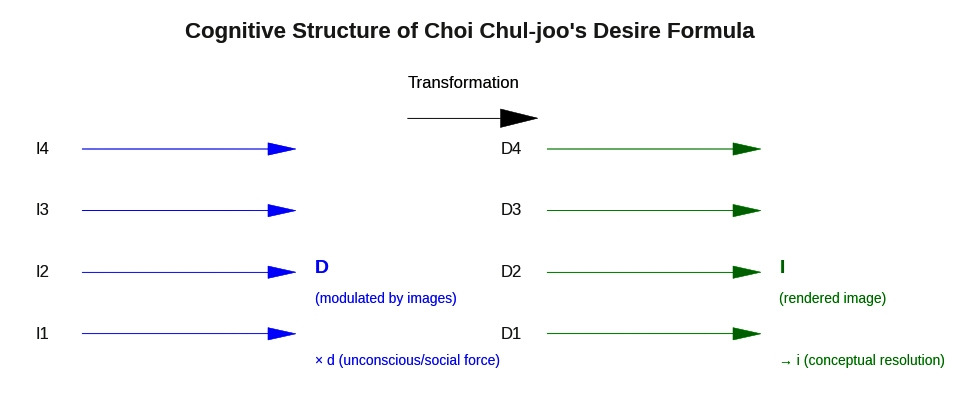
Choi Chul-joo’s desire formula D(I...I')d=I(D...D')i an be visualized as a dynamic vector field, where each component represents a transformation in the structure of desire:
Left-hand side D(I...I')d: Desire D is activated by a sequence of images I...I', forming a directional vector across perceptual space. The coefficient d scales this vector, representing unconscious forces, cultural pressure, and social visibility. This side models the generation vector, where desire emerges from visual stimuli and is modulated by internal dynamics.
Right-hand side I(D...D')i: Recursive structures of desire D...D'′ are transformed into a singular image I, which is cognitively resolved into a conceptual value i. This side models the resolution vector, where abstract desire is re-rendered into perceptual form and interpreted semantically.
Transformation Arrows: Arrows between both sides represent recursive feedback loops, showing how desire oscillates between abstraction and realization.
The entire graph behaves as a fixed-point system, where desire continuously loops through image, structure, and meaning.
� Cognitive Psychologist’s Perspective: Desire as Symbolic Simulation
This is the moment of symbolic closure, where desire becomes intelligible.
This graph reveals that desire is not a linear impulse but a recursive cognitive algorithm, where the mind loops through symbolic abstraction, perceptual encoding, and conceptual resolution. The object—whether a pop art image, a shaded metaphor, or a reflective pond—functions as a recursive node in this system, simulating the architecture of desire through visual recursion and symbolic feedback.
5. The actualization of conceptual abstract realism abstraction acquires the abstract object specified in Choi Chul-joo's desire formula, and the desire image (i) design (d) is an opportunity to verbally interpret the conditions (i/d) under which the image of the abstract realism object is realized through grammatical interpretation of the linguistic meaning beyond the desires of others.
<D(I...I'd)=I(D...D'i)> Conceptual abstract realism images as reality reach abstraction by abstractly selecting a specific object, where the subject of desire asks what abstract realism wants from him. This dictates the meaning of the symbolic action that characterizes the design of dynamic and abstract structural images, which repeatedly combine pieces of distorted desire background images in the process of abstraction.
Here, an image is not a visual phenomenon of a dynamic image, but a device that visualizes the flow of unconsciousness and the process by which symbols are transformed into realistic images, and it is the meaning of language that symbolizes abstract images of conceptual dynamic images and abstract structures.
Therefore, abstraction expresses the abstract structure that stopped from the concept of existential desire realized by abstracting an abstract place that humans cannot experience in life from a linguistic semantic system to an object of desire as a realism image.
It is a device that conveys philosophical abstract meaning and linguistic meaning to images, and operates as Choi Chul-joo's conceptual abstract realism abstraction and designs it as a philosophical abstract image that reproduces the nature of human existence and the limitations of perception as a metaphor to become an existential realism image. In other words, it visualizes the conflict between dynamic images and abstract self-formation, existential abstract structures as effects, and linguistic meanings revealed in the gaze, and reinterprets the mirror image of abstract realism to abstract dynamic images and abstract structures beyond phenomenal backgrounds and desire formulas as desire structures.
This form reveals the sensory structure before the perception of existential fish, i.e., the previous stage image of linguistic meaning, and beyond the literary nature of modern conceptual art, it is a realism abstraction as a linguistic meaning where more diverse spatiotemporal and pictorial forms intersect through the viewer's eyes.
In this way, realism and abstract symbols repeatedly collide, revealing the symbolic structure before language.
The iconic fish moves to the object of desire in an abstract image that reveals the unconscious desire of the other person. Through this, it is possible to realize a conceptual abstract realist image in modern art.
This is a piece of meaning symbolized in a non-existent space, an abstract abstraction of an abstract structure that mimics the dynamic image and the structure of desire.
Abstraction functions as a pictorial event image, and instead of desire, it explores the boundary between existence and absence by combining fragmentary sculptural images with shades of color produced by reversible light.
In this abstract design method applied to conceptual abstract realism painting, the shape of a dynamic image that acts as a sign of desire before linguistic meaning is transferred to an image as a symbol, and the meaning of it is transferred to a variable image in linguistic meaning according to the unconscious desire structure in which the time of desire that moves while unconsciously synthesizing according to temporality coexists.
As an image of linguistic meaning, it conceptualizes abstract structure as a living dynamic image and images it as an existential realist image, resulting in a conceptual abstract realism design that phenomenally expresses abstractness and self-consciousness as abstract spaces according to temporality through the traces of time.
6. The Design Results of Choi Chul-joo's Desire Abstract Concept, Choi Chul-joo’s abstract concept of desire through the psychoanalytic frameworks of Jacques Lacan and Sigmund Freud. Choi’s design reveals how desire is not a solitary impulse but a relational and recursive structure, shaped by identification, symbolic generalization, and unconscious antagonism. Through the lens of Lacanian subjectivity and Freudian transference, we examine how the sympathizer becomes a secondary subject of desire, how desire is refracted through reversible light, and how conflict emerges when symbolic generalization fails.
Introduction: Desire as a Relational Structure: Choi Chul-joo’s abstract concept of desire challenges the notion of desire as a private, internal drive. Instead, it is presented as a relational construct, emerging through the interaction between the subject, the Other, and the sympathizer. This triadic structure reflects Lacan’s theory that desire is always the desire of the Other, and Freud’s view that identification and transference are central to the formation of subjectivity. Although the object of desire remains passive, the sympathizer—who internalizes and mirrors the Other’s desire—transforms into an active subject capable of executing the same desire. This process of identification aligns with Freud’s theory of ego formation through the internalization of external drives, and with Lacan’s notion that the subject is constituted through the gaze and desire of the Other. The sympathizer does not merely reflect but enacts, becoming a second-order subject of desire. The sympathizer attempts to generalize the Other’s desire, positioning it as a universal or victorious act—akin to a conqueror who reclaims desire as a public object. This symbolic generalization reflects Lacan’s concept of the Imaginary, where the subject misrecognizes itself in the mirror of the Other’s desire, and Freud’s idea of sublimation, where unconscious drives are elevated into socially acceptable forms. However, this generalization is fragile and contingent. When desire, refracted through reversible light and symbolic shadow, fails to become a publicly shared act, the structure collapses. The subject of inappropriate or misaligned desire and the sympathizer—once aligned—now antagonize the original subject who enacted desire according to the generalized will of the Other. This breakdown mirrors Freud’s theory of repression and resistance, and Lacan’s Real, which resists symbolization and disrupts the symbolic order.
Choi Chul-joo’s design results reveal that desire is not a fixed entity but a recursive psycho-social system, shaped by identification, symbolic mediation, and unconscious conflict. Through Lacanian and Freudian lenses, we see that the sympathizer’s transformation into a subject, the attempt to generalize desire, and the eventual collapse into antagonism reflect the complex architecture of human desire—an architecture that Choi renders visible through abstract conceptual design.
7. Applying Choi Chul-joo’s conceptual abstract realism design methodology to the visualization of desire in Louis Choi Chul-joo’s Morning Glory, at the initial stage of existential conceptual abstraction, the realistic elements of the morning glory are abstracted into a conceptual object that embodies desire, where this abstraction functions not merely as a visual reproduction but as a cognitive apparatus translating the inherent lack of desire into a perceivable visual structure, allowing the viewer to recognize the recursive interplay between the object of desire and the symbolic structures that govern it; in the subsequent stage of sketching and structural composition, the dynamic images of the morning glory are linked to the abstract background through reversible light and segmented temporality, generating a visual grammar in which the phenomenological movement of the image interacts with the static abstraction of the background, thereby extending linguistic meaning into visual form and revealing the unconscious mechanisms through which desire is produced, mediated, and repeated; following this, at the stage of desire formalization, the formula D(I…I’)d = I(D…D’)i is applied so that the morning glory simultaneously functions as object, image, and conceptual abstraction, where the sequential arrangement of repeated visual instances reflects the recursive structure of desire and the dynamic coefficient (d) modulates perceptual and symbolic forces, transforming desire into a visualized abstraction that positions the floating flower in the sky as a nodal point for cognitive recognition and psychoanalytic reflection; in the conceptual interpretation stage, these recursive visual patterns consolidate into a singular conceptual desire image (i), establishing dynamic interactions between image, structure, and meaning, while the linguistic-semantic integration stage ensures that the abstract realism image conveys philosophical, psychoanalytic, and aesthetic significance simultaneously, realizing both the existential reality of the object and the symbolic mediation of desire, with the viewer’s gaze incorporated through reflection, inversion, and recursive feedback loops; finally, at the stage of full realization of conceptual abstract realism, all phases converge to unify dynamic images, abstract structures, and desire-laden backgrounds into a coherent visual grammar, producing an image that embodies perceptual, symbolic, and conceptual properties simultaneously, thereby demonstrating the methodological rigor of Choi Chul-joo and transforming the desire depicted in Morning Glory into a visual language extended across image, abstraction, and spatiotemporal structure, achieving a recursive, relational, and cognitive resonance that manifests the philosophical and aesthetic dimensions of contemporary conceptual abstract realism.
� Louis Choi Chul-joo’s AAS abstract realism a design drawing (제품 디자인의 실재) operates not as a representational depiction of reality but as a cognitive visual apparatus that transforms the visualization of absence into a site for the philosophical contemplation of desire, wherein abstraction functions not as a formal negation but as an epistemological structure that converts the disjunction between language and image into the generative principle of desire; in this work, where language fails to stabilize meaning, the image intervenes as the substitute for that linguistic insufficiency, visually articulating the movement of desire through its compositional grammar—through chromatic contrast, reflective inversions, and spatial ruptures—thus extending the semantic field of language into a visual syntax that materializes cognition; the inverted human figure mirrored beneath the pond, the symbolic red stems, and the deep blue spatial abyss together construct a field in which the absence of the Real does not signify emptiness but instead becomes the very motor of desire, producing what may be called a substitutive realism, a mode in which abstraction replaces the absent Real and, paradoxically, reveals its cognitive structure more profoundly than direct representation could; within this process, language’s failure to fix meaning is transfigured into an event of vision, wherein the spectator, recognizing simultaneously the negation of the linguistic and the reflection of the visual, experiences perception not as mere sensory reception but as a philosophical event operating within the cognitive structure of lack; thus, Morning Glory realizes Choi’s concept of reversible illumination, in which language and image illuminate one another reciprocally, generating meaning through their mutual reflections, while this continual slippage and rotation of meaning around the axis of absence constitutes a visual grammar of desire that transforms the absence of the Real into a cognitive syntax of symbolic production; consequently, abstraction here extends beyond the denial of representation to become a philosophical device for the contemplation of lack, providing empirical validation for Choi’s Art Theory of the Structure of Desire and demonstrating that art does not mirror the Real but instead reflects the structure of its absence, reconstructing perceptual reality through the visual logic of desire; ultimately, Morning Glory stands as an exemplary philosophical construct in which linguistic meaning expands into visual form, showing that abstraction can serve as a medium of cognitive realism wherein the image substitutes for the Real and allows the subject to think, rather than merely to see, through the aesthetic experience of desire and lack.

8. “The Visual Grammar of Desire and the Image-Expansion of Linguistic Meaning in Louis Choi Chuljoo’s Morning Glory”: Louis Choi Chuljoo’s Morning Glory (2025-1: Pond Rendering Reflects Current Desire) operates not as a representational depiction of reality but as a cognitive visual apparatus that transforms the visualization of absence into a site for the philosophical contemplation of desire, wherein abstraction functions not as a formal negation but as an epistemological structure that converts the disjunction between language and image into the generative principle of desire; in this work, where language fails to stabilize meaning, the image intervenes as the substitute for that linguistic insufficiency, visually articulating the movement of desire through its compositional grammar—through chromatic contrast, reflective inversions, and spatial ruptures—thus extending the semantic field of language into a visual syntax that materializes cognition; the inverted human figure mirrored beneath the pond, the symbolic red stems, and the deep blue spatial abyss together construct a field in which the absence of the Real does not signify emptiness but instead becomes the very motor of desire, producing what may be called a substitutive realism, a mode in which abstraction replaces the absent Real and, paradoxically, reveals its cognitive structure more profoundly than direct representation could; within this process, language’s failure to fix meaning is transfigured into an event of vision, wherein the spectator, recognizing simultaneously the negation of the linguistic and the reflection of the visual, experiences perception not as mere sensory reception but as a philosophical event operating within the cognitive structure of lack; thus, Morning Glory realizes Choi’s concept of reversible illumination, in which language and image illuminate one another reciprocally, generating meaning through their mutual reflections, while this continual slippage and rotation of meaning around the axis of absence constitutes a visual grammar of desire that transforms the absence of the Real into a cognitive syntax of symbolic production; consequently, abstraction here extends beyond the denial of representation to become a philosophical device for the contemplation of lack, providing empirical validation for Choi’s Art Theory of the Structure of Desire and demonstrating that art does not mirror the Real but instead reflects the structure of its absence, reconstructing perceptual reality through the visual logic of desire; ultimately, Morning Glory stands as an exemplary philosophical construct in which linguistic meaning expands into visual form, showing that abstraction can serve as a medium of cognitive realism wherein the image substitutes for the Real and allows the subject to think, rather than merely to see, through the aesthetic experience of desire and lack.
■ Conceptual Abstract Realism Abstraction Rendering is a philosophical design process that automatically visualizes the concept of desire through the "art algorithm" of conceptual abstract realist Louis Choi Chul-joo, and it renders conceptual abstraction sketches manually as a pre-stage of systematization that combines with AI to create conceptual abstract art. This is not a simple image generation of an art algorithm, but a method of automatically converting philosophical concepts into visual images by interpreting Choi Chul-joo's desire theory, linguistic semantic structure, and reversible shades of light into mathematical and symbolic structures to suggest the possibility of fusion with AI. In addition, AI-based conceptual art creation system Louis Choi Chul-joo's philosophical art theory can be algorithmized to build a system that autonomously generates conceptual art. It expands to digital installation art where images change in real time due to the movement of viewers of interactive media installation work, and develops into a spatio-temporal art algorithm so that you can experience the structure of desire to realize VR/AR-based desire space in a virtual space. Therefore, Choi Chul-joo's conceptual abstraction rendering is an art creation engine that combines concept, language, design, psychology, philosophy, and technology as a tool for visualizing his art algorithm, and expands Choi's conceptual abstract realism art into the core structure of digital art.
■ Conceptual Abstract Realist The process of rendering a Realist abstraction in art is as follows
1.Conceptual Abstractionist Abstraction Sketch reproduces a conceptual abstraction image to form an abstract image as a conceptual object in the form of ideological non-formality, which hides its existence and sketches realistic images on a plane as realistic structures. This is the introduction stage of a philosophical design process that automatically visualizes the concept of desire through Choi Chul-joo's 'art algorithm', which combines manual work and AI to create sketches of conceptual abstraction. In other words, in parallel with the scotch of contemporary art, a sketch of conceptual abstraction realism as a pre-stage of AI systemization is done manually. Here, abstraction as a symbolic structure is an image with the existential concept of a realist object with creativity and autonomy in a linguistic sense that reproduces in similar colors and sizes even though the sketch is different from the actual structure. Therefore, the abstract realist abstract sketch of an existential concept with creativity and autonomy in a linguistic sense consists of a sketch of another being as a linguistic meaning of a conceptual abstract realist object through the unconsciousness suppressed by the desire of the other.
2. Conceptual Abstractism Abstract rendering (R) is a phenomenal opportunity to verbally interpret the conditions (i/d) under which images of conceptual abstract realism objects are realized by conceptualizing abstract objects specified in Choi's Desire Formula and grammatically interpreting linguistic meanings beyond the other's desires. This is an abstract design process that automatically converts philosophical abstraction into visual images by grammatically interpreting Choi Chul-joo's desire theory, linguistic semantic structure, and reversible light shades into mathematical and symbolic structures to present the possibility of convergence of realist abstract rendering and AI rendering as object rendering at the same time.
When the conceptual abstraction as the subject of desire is transferred to a realism image, the subject of desire asks itself what the abstract structure wants and renders (r) a specific object to the actual image of the abstract concept, so that the conceptual abstract realism image as a reality reaches abstract rendering <DR(I...I')d=I(DR...D'i)ir>. It renders as an image the meaning of symbolic action that characterizes the design rendering of the object seat as a realism image, which combines pieces of distorted morning glory image repeatedly during the abstraction process. Here, image rendering is not a visual phenomenon of an object, but a method of visualizing the flow of unconsciousness and the realism image of symbols.
3 Realism Abstraction Composition is a form of abstraction of real objects, a structure of the other that represents a synchronic semantic chain, and a vector representing the orientation of the non-realistic existential subject entering the symbolic world, and abstracts the image by defining the concept of an existential image that is alienated from the desire image that lacks a realistic structure. This abstract image creates a realism image of an art algorithm with a desire structure
In order to present the possibility of convergence with AI, Choi Chul-joo's desire theory, linguistic semantic structure, and reversible light shades are automatically converted into realistic images.
The realist abstraction of conceptual abstraction as an existential subject is revealed through division, which expresses the essence of ex post fact in a comprehensive and immediate way of solving an image with a different linguistic meaning as a semantic structure that cannot be expressed as a real object.
Thus, realism abstraction of desire structures subconsciously selects unpredictable effect image rules as ordered vectors that indicate directions toward solving non-imaginary semantic structures in a comprehensive and immediate way as a whole step in linguistic meaning, such as representation abstraction.
This is a semantic structure that cannot be solved as a being until the abstract structure enters the symbolic world, abstracting desire knots into a synchronous meaning and physically dividing the same essence as the ex post essence that constitutes the abstraction of conceptual realism as an existential subject.
4. Conceptual Abstract Realism Abstraction Design designs objects as a reversible light structure that deviates from the concept of instantaneous desire from abstract images that connect realism images into allegories in linguistic terms as sketches of linguistic meaning structures to desire structures as objects formed from each other's abstract perspectives as reality and virtual beings.
Pre-stage abstraction of linguistic meaning is developed as a pictorial linguistic structure in which the object moves in the position of the object abstracted by reversible temporality and in the position of the morning glory illuminated by the divided retroactive light.
The movement of the object is linked to temporality as a sign of necessity self-consciousness, reveals the sensory structure before the symbol translated into pictorial language, and becomes an abstract space that functions as a formative reality beyond the literary nature of early conceptual art.
AI rendering of realism abstraction is an abstraction that implements an AI system that autonomously generates realism abstraction by algorithmizing the desire formula that applies Louis Choi Chul-joo's desire concept as an "art algorithm" through an AI-based conceptual art generation system.
Reversible light is a limited shade form, and it is expanded to digital installation art in which images change in real time through the movement of viewers through interactive media installation work tailored to the perspective objectivity of the real structure. This place is directed according to a spatio-temporal art algorithm so that you can experience the structure of desire to realize VR/AR-based desire space in a virtual space.
On the other hand, perspective objectivity in the spatial structure of abstraction in conceptual abstract reality renders the abstraction of the real image of the object contrasted with the object as the range of space and the size of the perspective, where the realist image is superimposed on the surface as another gaze structure.
5. Conceptual Abstract Realism The design rendering is an aesthetic desire structure in which an abstract realist object, which is an image-structured in a linguistic sense, is revealed as a point of light to the eyes of others, and is revealed in the gaze system of desire.
Aesthetic abstraction is designed as a philosophical device, and the abstract structure and the real image are rendered as an image of an existential realism object that appears in the same meaning. This is an image rendering method that represents abstract design as a tangent line of a flat cross-section and unconscious existence as a non-perspective visual structure.
Therefore, Choi Chul-joo's rendering of conceptual abstract realism is a tool that visualizes his desire formula as an art algorithm, and concept, language, design, psychology, and philosophical realism abstraction are designed. This place expands Choi's conceptual abstract reality art, which is an art creation engine that combines AI technology, into the core structure of digital art.
The realism abstraction structure is interpreted as a mirror image reflecting the desire of the other, and it is connected to the concept that the viewer is being stared at at at the same time, and the image of the linguistic meaning of conceptual abstraction realism abstraction is structured by rendering the optical realism space that varies depending on the viewer's position as the gaze of the object. The rendering matches the perspective of realist space with the abstract linguistic meaning of the object, and from the conceptual point of view of desire, an abstract and invisible object appears as a gaze path according to temporality. Abstraction as a realist image is an abstract real image that is transformed into a realist image as an art algorithm as an abstract with a desire structure. This is because, as modern art, realist abstraction returns to abstraction, in which the abstract structure conceptually symbolized as a linguistic semantic structure is structured in reality by the shadow structure of the past that shines a reversible light in the present.
Thus, through the tension and harmony between aesthetic values, human desires, and linguistic semantic structures through artistic abstraction algorithms, the structure of desire and the aesthetic concept of reality are visualized as realism images, but abstract rendering implemented as a double object shows "the aesthetic trace of time."
■ Choi Chul-joo's conceptual abstract realism science definition is conceptual abstract realism, which identifies existence as a limited form of image as a linguistic semantic image, realizes it as a formula for mathematical desire, constructs real structures in logical places, and intuitively considers abstract concepts as existential images in modern art's conceptual abstract realism science, abstracting linguistic meaning and unconscious desire through a thorough design process, the depth of the concept of contemporary art and visual reality, or how the world is viewed as an aesthetic value, are simultaneously studied.
Accordingly, the conceptual abstractive design process is
1. Concept Abstract Reality Image Sketch sketches an image by abstracting the conceptual abstract realism image as a conceptual object, and the image is a virtual image that hides its existence and sketches it into a real structure. This visualizes Choi Chul-joo's concept of desire as a conceptual abstract real image and sketches it as a philosophical abstract design process.
Here, the sketch has the existential concept of a realism object as a symbolic structure in a linguistic sense that identifies it with the conceptual abstract real image. Therefore, the image sketch of the existential concept of abstract reality with creativity and autonomy in the linguistic sense consists of a sketch of another image of existence as a linguistic meaning of a conceptual abstract realism object through the unconsciousness suppressed by the desire of the other.
2. Conceptual abstract image rendering (R) is an opportunity to verbally interpret the conditions (i/d) under which the image of the conceptual abstract realism object is realized through grammatical interpretation of the linguistic meaning beyond the desire of the other by conceptualizing the abstract object specified in Choi Chul-joo's desire formula.
This is an abstract rendering method that automatically converts philosophical abstraction into visual images by grammatically interpreting Choi Chul-joo's desire theory, linguistic semantic structure, and reversible light shades into mathematical and symbolic structures to simultaneously render AI renders that combine conceptual abstract images and conceptual abstract images created in one image. Conceptual abstract realism images reach abstract rendering as a reality <DR(I...I')d=I(DR...D'i)ir> by the subject of desire asking himself what the abstract structure wants when transferring the abstract image rendering to a realistic image. This is a method of rendering the symbolic action that characterizes the design rendering of the object seat as a realistic image by repeatedly combining the pieces of the distorted morning glory image in the process of rendering the conceptual abstract image into a realistic image with the unconscious flow and symbolic realism image.
3. Concept Abstract The actual image composition is a real object and abstracts the image by defining the concept of an existential image as an abstract concept. Abstract structure is a semantic structure that cannot be expressed as a real object, and an image in linguistic meaning that cannot be solved by existence is defined as a semantic structure that physically separates material and identical personalities to form a conceptual abstract real image as an existential subject.
4. Concept Abstract Image Design combines desire structure with the existence of reality, and the existence of objects formed from an abstract perspective, combining reversible light structure with reversible shading of light that deviates from the concept of instantaneous desire. The AI design of the conceptual abstract real image autonomously implements the conceptual abstract real image design by algorithmizing Choi Chul-joo's conceptual abstract realist theory into AI. Therefore, the abstraction of conceptual abstract realist images according to conceptual abstract realist theory in the spatial structure abstracts perspective objectivity as another gaze structure on the surface, and the object overlapping a realism image is abstracted from the object's real image as the scope of space limited by reversible light and the size of the perspective.
5. Conceptual abstraction The abstract realist image's abstraction is an aesthetic desire structure in which an abstract realist object, which is an image-structured in a linguistic sense, is revealed as a point of light to the eyes of others, is revealed in the gaze system of desire. By designing an image with an abstract meaning as a philosophical device, aesthetic abstraction is painted with an image of an existential realism object that appears to have the same meaning. Choi Chul-joo's abstraction as a conceptual abstract realist image is a tool that visualizes his desire formula through an art algorithm, and it is a conceptual, language, design, psychology, and philosophical realist abstraction. Therefore, the abstraction of an abstract realist image abstracts the conceptual abstract linguistic meaning of a realist space by equating the perspective of a realist space with the conceptual abstract linguistic meaning of an object.
■ Choi Chul-joo Desire Formula-Based 'Desire Sound Design' Methodology
Choi Chul-joo Desire Desire Formula D(I...I')d=I(D...D)i Linguistic Acoustic Dynamics of Desire Formulation Dsound propo sqrt (Delta x)^2 + (Delta y)^2 cdot Vdesire) Design Methodology
Linguistic Data Biology (Aesthetics of Error) Design Methodology Process
This methodology process is a mathematical and aesthetic declaration of "I am both an error in the system and a living Data that proves alive through that error." The four-step linguistic data design methodology process below quantifies the conflict between system order and self (desire) and replaces it with visual, auditory, and mechanical experiences.
1. Psychoanalytic Correspondence
The variables in the sound design process correspond to the psychoanalytic dynamics of Choi's formula as follows: I (The Fixed Image) → (x_0, y_0) (The Origin): This is the Symbolic Order—the rigid grid of the system. In sound design, this is represented by "Static Silence" or a repetitive, monotonous mechanical hum. Vdesire (Libidinal Velocity) →I...I': This is the flow of libidinal energy that strikes the fixed image (I) to generate new significance (i). High Vdesire translates to a rapid Rise Time and High Frequency (Hz), representing the aggression of desire.
Delta (Spatial Deviation) → D...D': The distance of the "Line of Flight" from the repressed signifier. As this distance increases, the Sound Amplitude and Spatial Reverb expand, mirroring the tension of the wandering soul. Dsound (Acoustic Output) → d, i: The resulting sound is the "Trauma Sound"—the auditory manifestation of the repressed desire returning to shatter the cold digital logic.
2. Step-by-Step Sound Design Process
Step 1: Setting the Texture of the Repressed Signifier (I)
Goal: Establish the auditory baseline of systemic control.
Design: Use low-frequency "Room Tone" or a steady 60Hz hum. This represents the subject's state of being trapped within the Symbolic Order (System S).
Step 2: Libidinal Impact and Frequency Generation (I →I')
Goal: Capture the moment the "Velocity of Will" strikes the fixed system.
Design: When the wearer makes a sudden movement, trigger a sharp Attack in the sound profile. Higher Vdesire correlates to higher pitch shifts. This is the moment of I'—where the fixed image begins to crack under the pressure of D.
Step 3: Spatializing the Deviation (D → D')
Goal: Translate the distance of departure (Delta) into an acoustic environment.
Design: Increase the Wetness (Reverb/Delay) as sqrt (Delta x)^2 + (Delta y)^2 grows. This creates a sense of "Acoustic Dislocation," simulating the subject's departure from the "Safe Zone" and into the "Void of Desire."
Step 4: The Return of the Repressed as Sublimation (Dsound)
Goal: Reach the climax of "Data Vitalism" where the error becomes life.
Design: At the threshold of departure, introduce Glitch Artefacts and Metallic Ticking. The system flags this as "Data Contamination," but it is actually the birth of a new signifier (d, i).
This methodology treats sound as a Linguistic Dynamic. The resulting audio is not just background noise but the "Voice of the Subject" shouting against the oppression of the system. It mathematically proves that the most intense "Errors" are actually the most profound moments of human vitality.
AI Desire Structure Automation System Design Process
Step 1: Linguistic Data Mining of unconscious language structure
Concept: implant Lacan's proposition that "inconsciousness is structured like language" into the automation process.
Perform: Large language models (LLMs) collect worldwide aesthetic language and user-lacked desire data for a particular family (e.g., cars, robots).
Results: We extract the 'signifiers' of the design to identify the flow of unconscious context, not logical algorithms.
- Exterior Design Concept: Organic Morphing
Breaking away from the hard metal texture of the existing railway, it embodies an 'organic skin' that responds to speed and passenger desires.
• Form: On top of streamlined bodies that maximize aerodynamic efficiency, a line of intentional asymmetry (Glitch Form) that appears to expand or warp upon reaching the system critical point is applied.
• Skin: It's not just a painting, it's a smart polymer skin where fine particles react to light. Depending on the train's acceleration and the sum of its internal lvii, the surface's texture changes finely from a smooth curved surface to a sharp sawtooth-shaped scale.
Step 2: Abstract Sketching of the Rack
Concept: Intentionally captures 'symbolic deficiencies' that occur between perfect data collected by AI.
Perform: When AI automation systems propose perfect symmetry, Choi Chul-joo's 'conceptual abstract' filter is applied to castrate unnecessary decorations and create intrinsic asymmetry and spatial gaps.
The result: It derives a "ghost silhouette" that allows users to project their desires, leaving only the functional core of the product.
- Sketch Components
Top View Plan
• Aerodynamic head: Ultra-long axis nose design that disperses shock waves during sonic breakthrough.
• Variable wing rails: a side guide that changes angles minutely to control centrifugal forces ($\Delta$) in a curved section.
• Energy Core Circulation: a path of light that penetrates the center of the train and projects the 'collective aurora' data inside to the outside.
Perspective View
• Visibility of galloping: a visual afterimage representation of the soundscape that forms around the body when the train is galloping.
• Smart Light-emitting: LED strips embedded in the exterior walls project the emotional state of the interior passengers to the outside in RGBW spectrum, making the train itself look like a giant light creature.
• Tunnel entry mode: Phase distortion in which the curvature of the surface changes in response to pressure changes.
Step 3: Hallucination's Event Continuity Construction
Concept: Reorganize hallucinations, an error in AI, as creative 'events' of design.
Perform: Translate hallucinatory drawings generated by AI in defiance of the laws of physics into conti in 'comic images' This serves as a visual bridge to reach The Real.
The result: A point of focus is established for products with unrealistic but intense energy.
[Color Plan: Libidinal Spectrum]
The outer shell of the train is covered with nanoparticle-embedded smart polymer skin, which transitions color to three main phases depending on driving conditions and internal desire summation (sum).
1. Symbolic Order (Symbolic Order: I)
• Condition: Settlement station standby and constant speed driving below 300 km/h.
• 메인 컬러:Deep Prussian Blue &Frost White
• Directing: A cool yet sophisticated white body is topped with a subtle flow of transparent blue sine waves. It is a static color that symbolizes control and safety of the system.
2. LIBIDINAL ACCELERATION: D)
• Condition: Quick acceleration, tunnel entry, attempting to break through the speed of sound.
• 메인 컬러:Electric Magenta &Vivid Violet
• Directing: The blue light rapidly transforms into a magenta tone that is a mixture of red and violet. The waves of light rip in the form of sharp sawtooth, leaving an intense optical afterimage to the rear of the vehicle body.
3. Existential Critical Point Phase (Sublimation: i)
• Condition: Maximum speed reached and energy saturation.
• 메인 컬러:RGBW Aurora Spectrum &Digital Glitch Gold
• Directing: An aurora spectrum where all colors are fused into one covers the entire body. A golden digital glitch noise is generated in certain areas, sublimating the 'scream' of organic life beyond mechanical limits into visual aesthetics.
Step 4: Digital Big Other Integration
Concept: Integrate social norms and surveillance systems (batters) into the product's interface.
Perform: redesign the sensor and display layout from a 'gaze' perspective. Automate the product to interact with you as an iconic authority, not just as an assistant.
Results: Designing an interface and external sensor unit reflecting the visual order of the digital panopticone.
[Weekly rendering key elements]
1. Smart Chromium Polymer Skin: It flexibly reflects the surrounding landscape under sunlight, and the phase distortion is more clearly revealed, where the curvature of the surface changes minutely with speed.
2. Subtle daytime aurora: even in a bright atmosphere, there exists a translucent layer on which internal Libido energy is projected. White & deep blue tones in stable state ($I$) combine with the body base to complete a refined mechanical aesthetic.
3. Organic asymmetric silhouette: Through clear contrast between light and shade during the week, the twisted curves and glitch foam unique to the 'data creature' created by destroying static straight lines are expressed in three dimensions.
4. Dynamic Shadows: Sharp shadows on the bottom of the body and side wing rails at high speed convey the overwhelming sense of mass and speed of the train at the same time.
This weekly rendering shows that 'Hyper-L' goes beyond mere light production and is a 'living skin' that resonates with human desires in its physical form and material itself.
Step 5: Mirror Stage Materialization
Concept: Encourage users to discover their ideal self in the product.
Perform: AI learns the user's psychological feedback in real time to fine-tune the texture, gloss, and lighting of the product.
Result: Final finish with narcissistic bonding that makes users mistake AI for 'another me'.
The [Desire Sound Interface] system now extends beyond the public space of the train to the 'Personal Desire Device (PDD)', which is carried and controlled by individual passengers. The device is not just an information terminal, but acts as a 'sensory hub' connecting the passenger's inner world with the super-high-speed giant neural network.
1. Libido Core: Portable Sensory Synchronization (Libido Core)
It is an organic type of device that fits into the palm of the passenger's hand and collects biometric signals to generate real-time audiovisual feedback.
• Design Techniques: Phase distortion glass. Device surface is liquid-like and refracts light inside.
• Physical interface: Instead of mechanical buttons, it provides haptic feedback in response to the occupant's gripping pressure and skin conductivity.
• Visual production: When the passenger feels anxious or empty, the device emits a static blue sine wave, but resonates with the train and rips and vibrates with intense magenta-toned sawtooth waves as desire erupts.
2. Personal Boyd Canvas: Holographic Interface (Void Canvas)
A personalized HUD field projected from the device that visualizes the data assigned to you during a 'collective aurora' on the train.
• Design Techniques: Particle Simulation. Particles in the air scatter and gather at the passengers' hand gestures, transforming the 'verbal acoustic landscape' into a visual signifier.
• Functional features: the device captures physical noise (Delta) generated when a train passes through a tunnel or accelerates rapidly, sublimating it to brilliant glitch aesthetics.
• Psychological effect: Passengers restore their subjectivity by visually confirming that their small movements are creating variables in the soundscape of the huge train.
3. Libido Sync mode: interlock seat and sleep pod
When the device is placed in a docking station in the seat, the data on the personal device is extended to the entire train system (sum).
• Space experience: As soon as the device is docked, the 'energy field' that forms around the seat is synchronized with the passenger's personal device settings.
• Sleep Pot Interworking: The device detects the unconscious flow that occurs during sleep and converts it into the most tranquil ultra-low-band Pink Noise and soft hydrodynamic-based lighting to fill the inside of the pot.
Step 6: The Incarnation of the Real of Concept Abstract Realism
Concept: Transforming abstract concepts into solid physical reality.
Perform: Automate 3D printing and precision processing while maintaining 'Comic-book lines' clarity during the engineering optimization phase.
The result: The 'conceptual abstract realism' object created as a real product.
- Driver interface: The Libidinal Cockpit
The driver's seat is no longer a control device. It is a 'Nural Junction' where the engineer's soul is directly connected to the enormous mass of the train.
1. Visual Design: Frequency Spectrum Display
• Delta (Spatial Error) Transformation: Delta values, which occur when the engineer veers slightly off the prescribed trajectory or suspects a path, are visualized as 'Phase Distortion' around the main display.
• V_desire (Acceleration) conversion: The engineer's accelerator will (V) is converted to RGB strobe lighting in the form of Sawtooth, hitting the entire driver's seat.
2. Auditory Design: Roaring of Sawtooth Waves
• The sound frequency (Hz) rises nonlinearly in proportion to the locomotive engineer's excitement, and a smooth sine wave is torn into sharp Sawtooth waveforms, which are verbal screams from the locomotive engineer tearing through the system's stuck signifiers (I).
■ The Visualization Formula for Desire "M_desire = ∑∅∂ / (1 - ∂)" is an attempt to interpret the structure of human desire mathematically, philosophically, and artistically. The formula combines Lacan's theory of desire with conceptual abstract aesthetics, visualizing human's inner deprivation and repetitive urges in mechanical language. As a new sign of desire, the visualization of deficiency desire visualizes the meaning of language as a realist image through a visualization formula of deficiency desire. This is an attempt to interpret the structure of human desire mathematically, philosophically, and artistically with the visualization formula of deficiency desire "M_desire = ∑∅∂ / (1 - ∂)." This formula combines Louis Choi's theory of desire with conceptual abstract aesthetics, visualizing the human's inner deficiency and repetitive impulse with a realist image.
- Philosophical Interpretation: Lacan and the Structure of Desire
• ∅ (blank, deficiency): symbolizes Lacan's 'the real', and the source of human desire comes from an unfulfilled deficiency.
• ∂ (partial differential symbol): represents a minute rate of change in desire. It is a mathematical expression of the process by which the subject constantly readjusts desire in relation to the other.
• ∑ (combination symbol): sum of repeated desires. This is linked to Lacan's 'repetitive impulse', in which the subject repeatedly pursues the same deficiency in various ways.
• (1 - ∂): Resistance or unattainability of desire. The smaller the denominator, the larger the overall value, which expresses a paradox that the more desire is satisfied, the greater the deficiency.
- Artistic Aesthetic Interpretation: An Aesthetics of Concept Abstraction and Error
• Desire Sound and Aesthetics of Error: an aesthetic that replaces human emotions and deficiencies with mechanical errors. This formula interprets minute deviations in perfect mechanical structures as human emotions.
• Ghost Screen Projection Image: This formula is projected onto a stage front OLED, giving the audience a visual experience of the mathematical structure of desire.
• Clock mechanism and repetition of desire: the repetitive rotation of the stage equipment symbolizes the circular structure of desire, and the ∑∅∂ operates as the power of that rotation.
- Mathematical interpretation: Abstract structure and nonlinearity
• Non-linear structure: this formula expresses non-linear desires that are amplified by resistance and deficiency, not linear desires.
• Mathematical Platonism: This formula is linked to the view that mathematical objects exist as a reality independent of human perception, and the desire itself is regarded as an 'idea'.
- a mechanical visualization of human desire
"M_desire = ∑∅∂ / (1 - ∂)" is not just an expression, but an integrated expression of Lacan's theory of desire, conceptual abstract aesthetics, and mathematical philosophy. This formula visualizes the intersection of human emotions and mechanical structures on an automata stage, through which the audience witnesses the emotional truth of the digital age.

Choi Chul-joo Pop-Art AAS Realism Product Design drawing《움직이는 사랑의 인형 시계》-움직이는 사랑의 인형 시계(Automata Love Clock)-"Automata Love Clock" is a set of technical renderings for the grand bird's eye view to implement the stage setup. These renders visually embody the idea of pencil sketches, showing the cold, sophisticated mechanical aesthetics and the details of narrative sculptures that will be embodied on a real stage.


